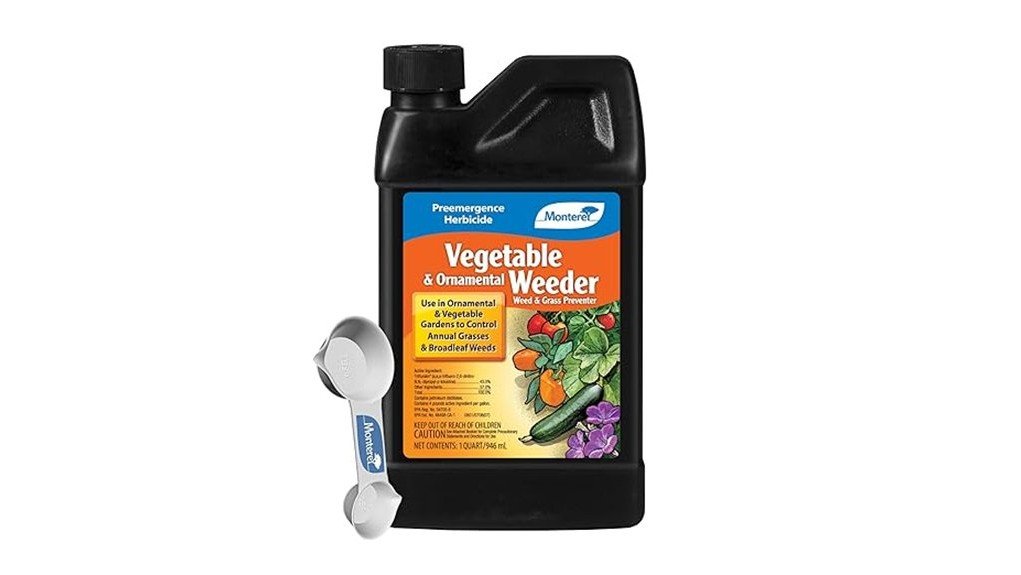
You’ll get a reliable preemergence weed barrier for vegetable beds, ornamentals, roses and established flowers, based on 43% trifluralin that blocks many annual grasses and broadleaf weeds when mixed and incorporated properly. The bundled measuring spoon simplifies the label rate of 3 fl oz per 2 gallons for about 1,000 sq ft, reducing dosing errors. It’s best for prepared, settled beds—not new seedings or transplants—and the next section covers application tips, safety limits, and alternatives.
Some Key Takeaways
- 32 oz bottle contains 43% trifluralin, a preemergence herbicide for annual grasses and many broadleaf weeds in beds and ornamentals.
- Label mixing: 3 fl oz per 2 gallons treats about 1,000 sq ft; included spoon simplifies accurate, repeatable dosing.
- Works when incorporated into the upper soil zone before germination; timing, soil prep, and even irrigation are critical for effectiveness.
- Avoid newly seeded areas, transplants, bulbs, windy or saturated sites; test small areas and follow label crop restrictions.
- Good value for home gardeners needing long-lasting barrier control, but compare granulars or higher-concentration concentrates for large areas.
What the Monterey Vegetable and Ornamental Weeder Is and Who It’s For
What makes the Monterey Vegetable and Ornamental Weeder useful for home gardeners and landscapers? You get a preemergence liquid with trifluralin (43%) that protects vegetable beds, ornamentals, roses, and established flowers from annual grasses and broadleaf weeds. You’ll appreciate the bundled measuring spoon and clear mixing rate—3 fl oz per 2 gallons treats about 1,000 sq ft—so application’s precise and repeatable. It’s suited to gardening beginners and urban gardeners who want reliable, long-lasting control without constant weeding. You’ll belong to a practical community of users who value efficacy, predictable coverage, and following directions to protect desirable plants. It’s an option for homeowners seeking crabgrass barrier products to protect lawns and landscaped areas.
How Trifluralin Works and What It Controls in Vegetable and Ornamental Beds
Understand how trifluralin protects beds: it’s a preemergence herbicide that stops weed seedlings by disrupting cell division in germinating roots and shoots, so seeds that try to sprout never establish. You’ll appreciate that its preemergence chemistry delivers seed germination inhibition targeted at annual grasses and many broadleaf weeds common in vegetable and ornamental beds. It acts in the upper soil zone, so timing and placement matter for effectiveness and plant safety. Evaluate intended-use labels carefully; when you apply correctly, trifluralin gives long-lasting, focused control that helps your garden community stay productive without constant hand-weeding. For homeowners seeking eco-conscious options, consider integrating organic fungicide alternatives into an overall pest-management plan.
Real‑World Performance: Coverage, Mixing Rate, and Application Tips
When you mix Monterey Vegetable and Ornamental Weeder at the label rate—3 fl oz per 2 gallons—you’ll reliably cover about 1,000 sq ft with effective preemergence protection; the concentrated 43% trifluralin formulation provides long-lasting suppression of annual grasses and many broadleaf weeds when incorporated into the upper soil zone and kept undisturbed. You should measure precisely with the included spoon, use a coarse spray nozzle and low pressure spray equipment to avoid drift, and calibrate gallons per 1,000 sq ft. Prioritize soil preparation—loose, firm seedbed—then time application before weed germination. Follow a consistent mixing technique and check local conditions. Consider integrating the product with irrigation zone valves to ensure even moisture and optimal incorporation after application.
Plant Safety, Restrictions, and When to Avoid Using It
Although trifluralin in this formulation gives good preemergence control, you need to take care with plant sensitivity, timing, and site restrictions to avoid harming desirable vegetation. You should avoid use near newly seeded areas, transplants, or bulbs unless label allows; seedbed timing is critical—apply only after final soil preparation and before seeds germinate. Make sure proper soil incorporation to reduce off‑target movement and protect shallow‑rooted ornamentals. Don’t treat windy, eroding, or saturated sites where runoff or drift could impact neighbors’ beds. When in doubt, test a small area and consult the label to confirm crop restrictions and safe intervals. For homeowners maintaining cool-season lawns, choosing cold-weather grass seed like cool-season grasses can help ensure establishment when planning post‑treatment reseeding.
Value Comparison: Price, Included Measuring Spoon, and Alternatives
Because the Monterey bundle includes a measuring spoon and a full 32 oz bottle of trifluralin you get ready-to-mix dosing and long coverage, but you should weigh that convenience against price and alternatives: the included spoon simplifies the labeled 3 fl oz per 2 gal dilution for treating 1,000 sq ft, reducing waste and dosing errors, yet if the bottle’s retail price is markedly higher than generic trifluralin concentrates or granular preemergence products, you may find better per-acre value elsewhere—compare active concentration, treated area per container, and whether alternatives require additional tools or incorporation steps before buying.
You’ll want a clear cost comparison versus alternative brands and generics, checking treated acres per dollar. If you value simplicity and fewer tools, Monterey’s bundle helps. If you manage large areas, shop for higher-concentration concentrates or granular options to stretch your budget. Many homeowners also use spreader calibration tools to ensure accurate application when switching between liquid concentrates and granular products.
Some Questions Answered
Is This Product Safe for Use Around Pets and Livestock?
No — it’s not automatically safe; you should minimize pet exposure and consider livestock safety. You’ll follow label directions, keep animals off treated areas until dry and per reentry intervals, store product securely, and avoid applying near water or feed. If pets or livestock contact treated soil, wash paws or hooves and consult your vet. For full reassurance, check the product label and contact the manufacturer for specific pet exposure and livestock safety guidance.
How Long After Application Can I Harvest Edible Crops?
You should wait the labeled harvest interval; follow the product’s edible waiting time before harvesting. Check the label for specific days for each crop—different vegetables may require different intervals. You’re protecting your family and community by respecting those limits. If the label’s unclear, contact the manufacturer or your local extension for crop-specific guidance. Keep records of application dates so you’ll confidently harvest only after the safe waiting time.
Can It Be Tank‑Mixed With Liquid Fertilizers or Other Pesticides?
You can, but you shouldn’t assume compatibility; always perform compatibility testing first. Mix small trial batches to check physical mixing and watch for separation or precipitate. Also test on a few plants to assess phytotoxicity risk before broad use. Record proportions and results so the group can repeat safe mixes. When in doubt, tank-apply separately or consult the label and manufacturer to protect plants and community gardens.
What Personal Protective Equipment Is Recommended During Application?
You should wear gloves, goggles, a respiratory mask, and chemical resistant boots during application. Use nitrile or neoprene gloves, sealed eye protection, and an N95 or respirator with organic vapor cartridge if mixing concentrates. Wear long sleeves, pants, and waterproof chemical resistant boots; avoid open footwear. Decontaminate equipment and launder clothing separately. If you’re uncertain, consult the label and join local gardening groups to share practical safety tips and experiences.
How Should Leftover Product and Empty Containers Be Disposed Of?
You should follow label instructions: never pour leftover product down drains or onto soil. Triple-rinse empty containers and use the rinse water in your spray mix. Dispose of rinsed containers and small amounts per local regulations—many areas accept pesticide containers at hazardous waste or recycling centers. Report larger quantities to collection programs. This minimizes environmental impact, protects your community, and helps you comply with rules so everyone stays safe.