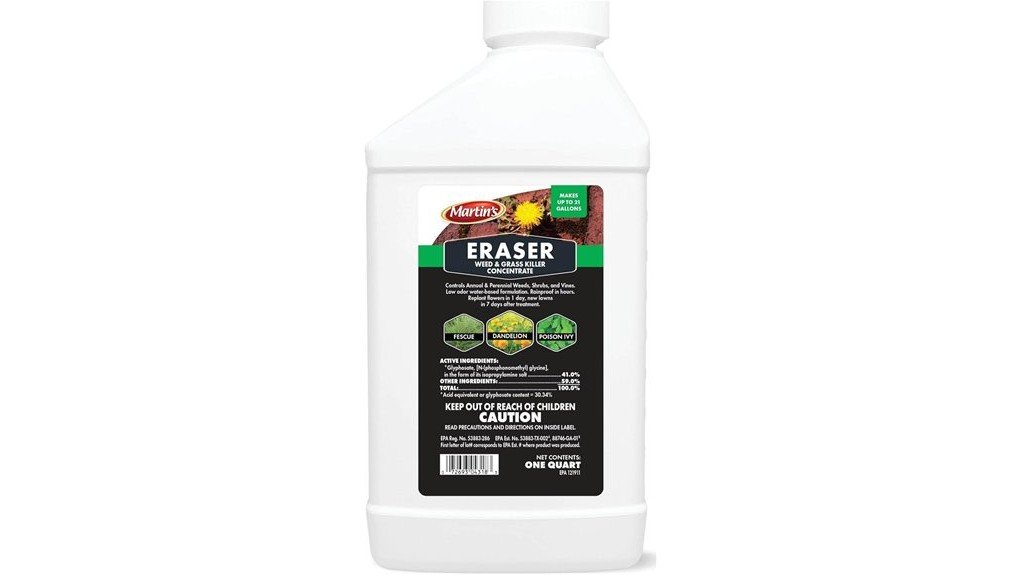
Control Solutions 82004318 Eraser & Grass Killer is a 1-quart, low-odor 41% glyphosate concentrate you’ll use for targeted post-emergent spot and perimeter treatments on annuals, perennials, grasses, vines and some woody plants. It translocates to roots for reliable top-kill and progressive root necrosis, leaves no soil residuals, and mixes for several gallons of spray; follow label rates, wear protective gear, and avoid drift. Keep reading for mix rates, coverage expectations, and resistance tips.
Some Key Takeaways
- Control Solutions 82004318 is a 1-quart, low-odor glyphosate concentrate with 41% active ingredient for broad-spectrum post-emergent control.
- It translocates to roots and rhizomes, giving rapid top-kill and progressive root necrosis for perennial suppression.
- Non-selective action kills any contacted vegetation and leaves no soil residual, allowing replanting after dieback.
- Mix per label in calibrated sprayers, apply to actively growing foliage, and observe rainfast and PPE requirements.
- Effective and cost-competitive for small-area homeowner and professional spot treatments, but rotate modes for resistance management.
What the Eraser & Grass Killer Is and Who Should Use It
The Control Solutions 82004318 Eraser & Grass Killer is a 1-quart, low-odor glyphosate concentrate (41% active) formulated for broad-spectrum, post-emergence control of annual and perennial weeds, grasses, vines, shrubs, and certain woody plants; it’s non-selective and leaves no residual soil activity. You’ll apply a water-based, concentrated herbicide designed for targeted spot and perimeter treatments. You’ll appreciate its technical labeling and predictable mode of action if you manage mixed vegetation. Recommended users include home gardeners seeking reliable patch control and property managers responsible for non-crop, turf, and industrial sites. Follow label directions and local regulations precisely. This product is especially useful for those focused on post-emergent weed control in lawn and landscape settings.
How the 41% Glyphosate Formula Performs on Common Weeds and Grasses
Having established what the product is and who should use it, let’s examine how a 41% glyphosate formulation performs against common weeds and grasses. You’ll observe broad-spectrum, post-emergent control of annuals and many perennials through systemic translocation to roots and rhizomes. Expect reliable top-kill within days and progressive root necrosis over weeks; this supports effective perennial suppression when applied at recommended rates. Non-selective action removes turf where contacted, so you’ll plan for turf recovery where desirable. Because the formula has no soil residual activity, you’ll replant or reseed without lingering herbicide interference once vegetation has died back. Homeowners should follow label directions and safety precautions when using non-selective herbicides to protect people and pets.
How to Mix, Apply, and Get Fast, Rainproof Results Safely
When mixed and applied correctly, Control Solutions 82004318 delivers rapid, rainproof weed control while minimizing off-target damage and exposure. You’ll follow label mix ratios for target species and application rates, using calibrated backpack or handheld sprayers. Wear required safety gear: chemical-resistant gloves, eye protection, long sleeves, and respirator if specified. Treat actively growing foliage; apply at low wind, avoiding drift and desirable plants. Allow the specified rainfast interval—typically a few hours—before irrigation. Rinse equipment per label, dispose of rinsate responsibly, and store concentrate securely. Record treatments for community accountability and safe, repeatable results. For best coverage and selective application, consider using spot weed treatment sprayers designed for homeowners to target weeds without impacting surrounding turf.
Pros, Cons, and Real-World Coverage Expectations (What 1 Quart Treats)
Because you’ll be balancing efficacy, cost, and safety, understanding the pros, cons, and expected coverage from one quart of Control Solutions 82004318 is critical for planning applications. You’ll appreciate pros: high glyphosate concentration (41%) yields reliable broad‑spectrum control, low‑odor formula, and fast rainproofing. Cons: non‑selective action risks desirable plant loss and requires strict adherence to application rates; no soil residual means re‑treatment for new emergence. One quart makes several gallons of spray; typical spot or small‑area mixes treat fences, driveways, and several hundred square feet depending on dilution. Always use appropriate safety gear and calibrated equipment. This product is commonly used by homeowners maintaining lawns and landscapes as part of crabgrass barrier strategies.
How It Stacks Up vs. Other Glyphosate Concentrates and Alternatives
Although many glyphosate concentrates share the same active ingredient, Control Solutions 82004318 stands out for its 41% glyphosate concentration in a low‑odor, water‑based carrier, which gives you comparable per‑unit efficacy to other professional‑grade concentrates while reducing handling nuisances. You’ll find its non‑residual, broad‑spectrum profile matches industry norms, so comparative field performance is driven by rate and application rather than formulation. For resistance management you should rotate modes and integrate cultural controls; glyphosate alone isn’t a system. In a straightforward cost comparison it’s competitively priced per acre for professional use, with quart packaging suiting targeted or small‑scale operations. Choose Safe Herbicides for a lush, healthy lawn.
Some Questions Answered
Is This Product Safe for Use Near Vegetable Gardens?
No — you shouldn’t use it directly in vegetable beds. You’ll risk drift risk to desirable crops, and although glyphosate has minimal soil persistence and no residual activity, off-target contact will damage plants. You should apply only to non-crop areas, avoid windy conditions, shield garden plants, and wait to replant according to label guidance. You’ll protect your garden by using spot treatments and physical barriers to minimize accidental exposure.
How Long Should I Wait Before Replanting Treated Areas?
You should wait at least 7 days before replanting small seeds and up to 30 days for sensitive transplants. Glyphosate-based products typically lack residual soil activity, so seed germination resumes once residues dissipate and the soil microbiome recovers. Monitor treated soil moisture and perform light tilling or rinsing if residues seem high. If planting high-value or sensitive crops, extend waiting to 2–4 weeks and conduct a germination test first.
Does the Concentrate Require Any Special Storage Conditions?
Yes — you should store the concentrate in childproof packaging, upright and sealed, away from children and pets. You’ll keep it in a cool, dry place observing temperature limits (avoid freezing or exceeding about 100°F/38°C). Don’t store near food, feed, or ignition sources. Keep original labeling intact and follow local disposal rules. You’ll also guarantee good ventilation and secure storage to maintain safety and product integrity.
Is This Glyphosate Formulation Pet-Friendly Once Dried?
No — you shouldn’t assume it’s pet-safe once dried. Glyphosate formulations can pose pet safety concerns and potential wildlife impact despite drying; residues or tracked particles may expose animals. Minimize risk by keeping pets off treated areas until fully dry and any label-specified re-entry interval has passed, storing product securely, and following application rates. Join community users who prioritize label compliance and habitat protection to reduce unintended exposure.
Are There Restrictions for Use in Organic-Certified Fields?
No — you can’t use it in organic-certified fields. Organic certification prohibits synthetic herbicides like glyphosate, so its use constitutes noncompliance. You’ll need to follow organic certification standards and avoid restricted applications that introduce synthetic residues. Consult your certifier for allowed alternatives, buffer requirements, documentation, and changeover timelines. You’ll maintain group trust by documenting practices and choosing approved organic weed-management methods to preserve certification and market access.