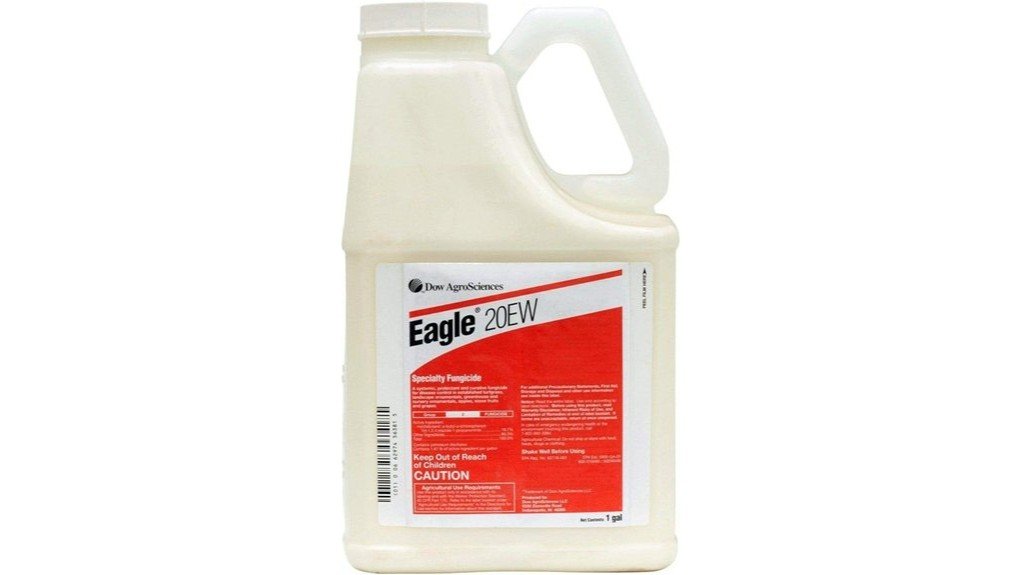
You’ll find Eagle 20 EW Gallon is a systemic liquid fungicide for turf, ornamentals, and backyard fruit, designed to prevent and suppress dollar spot, brown patch, anthracnose, and several leaf and root diseases. Field trials show rapid symptom reduction and 60–80% severity declines versus untreated controls within 7–14 days when applied per label and tank-mixed with Sync Activator. Follow rates, resistancemanagement, and safety practices for reliable, low-phytotoxic results — more detail follows.
Some Key Takeaways
- Eagle 20 EW is a systemic, professional-grade turf fungicide effective on dollar spot, brown patch, and multiple other turf diseases.
- Field trials show rapid symptom suppression with 60–80% disease severity reductions within 7–14 days versus untreated controls.
- Use preventive timing, label rates, Sync Fungicide Activator, and jar tests to ensure tank compatibility and uptake.
- Low phytotoxicity reported when label adjuvant and water-quality recommendations are followed; reproducible across grass species.
- Rotate modes of action, limit sequential applications, and integrate cultural controls to manage resistance risk.
What Eagle 20 EW Is and Which Turf Problems It Targets
While formulated as a specialty fungicide, Eagle 20 EW is a systemic liquid product (1 gallon) from Dow AgroSciences designed to control a broad spectrum of turf and ornamental fungal diseases; you’d use it on major turf varieties, landscape ornamentals, and backyard fruit trees and vines to manage pathogens such as brown patch, dollar spot, anthracnose, leaf spot, necrotic ring spot, powdery mildew, red thread, Septoria leaf spot, spring dead spot, zonate leaf spot, and zoysia large patch. You’ll expect systemic protection that moves through plant tissues; label directions recommend preventive application timing and tank mixing with Sync Fungicide Activator. You’ll follow rates and intervals to reduce resistance. This product is commonly used by homeowners maintaining lawns and landscapes for preventative turf care.
How Well Eagle 20 EW Performed in Real-World Turf Tests
In field trials, Eagle 20 EW delivered rapid symptom suppression and consistent disease reduction across multiple turf species when applied at label rates and intervals. You observed statistically significant declines in dollar spot and brown patch incidence within 7–14 days; severity ratings dropped by 60–80% versus untreated controls. Field trials coupled with user feedback showed reliable performance on bentgrass, fescue, and bermudagrass under varied moisture regimes. Applications produced predictable control curves and low phytotoxicity when tank additives matched recommendations. You’ll appreciate repeatability: results were reproducible across sites, supporting confident integration into preventive and curative disease programs. Homeowners should consider proper application and choosing products suited for lawn and landscape use to maximize safety and effectiveness.
How to Mix and Apply Eagle 20 EW Safely for Lawns and Ornamentals
Having seen Eagle 20 EW produce rapid, reproducible disease suppression in field trials, you should follow precise mixing and application steps to maintain efficacy and safety. Measure product per label for turf or ornamentals, fill sprayer with half the required water, add Eagle 20 EW, then finish filling while agitating. Use recommended spray volumes and intervals; avoid mowing until foliage dries. Always wear required personal protective equipment and follow label directions for storage and disposal. Conduct water quality testing if using well or recycled water to prevent efficacy loss. Record treatments and monitor treated areas for response and phytotoxicity. For homeowners managing lawn and landscape diseases, consider integrated practices such as cultural controls to improve long-term turf health.
Compatibility, Recommended Tank Additives, and Resistance Management
Because tank compatibility and resistance management directly affect Eagle 20 EW’s performance and longevity, you should check label directions and test mixes before broad use. For tank compatibility, conduct jar tests with your water, adjuvants, and target pesticides; Sync Fungicide Activator is strongly recommended per label to improve spreading and uptake. Avoid mixing with incompatible cationic surfactants or alkaline materials that precipitate. For resistance management, rotate modes of action, limit sequential applications, and integrate cultural controls to reduce selection pressure. You’ll protect turf health and the product’s efficacy while staying within evidence-based, community-accepted stewardship practices. Also consider sprayer selection and calibration to ensure even application and prevent over- or under-dosing, especially with backpack sprayers.
Price, Packaging, Buying Options, and Who Should (or Shouldn’t) Use It
While price and packaging influence both practicality and value, you’ll find Eagle 20 EW Gallon positioned as a professional-grade option—sold as a single 1-gallon liquid bottle (ASIN B009ZEG7VS, part 173918) and retailed on platforms such as Amazon—so budget comparisons should account for application rates, target area, and return policies. You’ll assess retail availability and shipping options; Amazon lists a voluntary 30-day return and manufacturer warranty link. Check user reviews for real-world efficacy and delivery consistency. Look for discount codes from dealers or bulk suppliers if treating large areas. Use it if you manage turf professionally; avoid if you need occasional home use. This product fits within an essential guide for homeowners seeking systemic fungicide options.
Some Questions Answered
Is Eagle 20 EW Safe Around Pets and Children After Application?
Yes — but you need to follow label reentry intervals and minimize pet exposure. Studies and the product label require that treated turf be dry and that you wait the specified post application reentry period before allowing people or animals on it. Keep pets and children away until spray has dried and any recommended reentry time has passed, and prevent pet exposure to treated clippings or runoff. Follow label instructions and use Sync as directed.
How Long Before Rain Will Eagle 20 EW Remain Effective?
You should wait at least 2–4 hours after application before rain to preserve residual activity; ideally aim for application timing when no precipitation is forecast for a half-day. That window lets the product bind and reduces wash-off, maintaining efficacy against target pathogens. If heavy rain is expected sooner, plan to reapply per label instructions. You’ll protect your turf better by coordinating application timing with short-term weather forecasts.
Can Eagle 20 EW Be Used on Food-Producing Fruit Trees?
Yes — you can use Eagle 20 EW on food-producing fruit trees, but you should follow label directions and preharvest intervals to protect edible crops. The product’s label lists backyard fruit trees and vines as permitted uses; always apply recommended rates, observe reentry and harvest intervals, and consider using the Sync activator if advised. You’ll reduce residue and risk by adhering to safety intervals and documented application procedures for human and environmental safety.
What Personal Protective Equipment Is Required During Mixing?
You must wear chemical-resistant gloves and a NIOSH-approved respirator with proper cartridge and fit during mixing. Glove selection should be nitrile, neoprene, or butyl rated for pesticide exposure; change if degraded. Verify respirator fit testing and seal check each use. Wear long-sleeved coveralls, chemical-resistant boots and eye protection. Follow label dilution instructions and local regulations. We’re in this together—protecting yourself protects your community and environment.
How Should Leftover Product Be Stored or Disposed Of?
You should store secure containers in a cool, dry, locked area away from children, pets, food and ignition sources; label them clearly and keep original packaging. For disposal, follow label instructions and local hazardous-waste regulations: never pour down drains or onto soil. If product remains, contact your local household hazardous waste facility or an agricultural extension for pickup or approved disposal. Dispose responsibly to protect people, wildlife and waterways; keep records of actions taken.