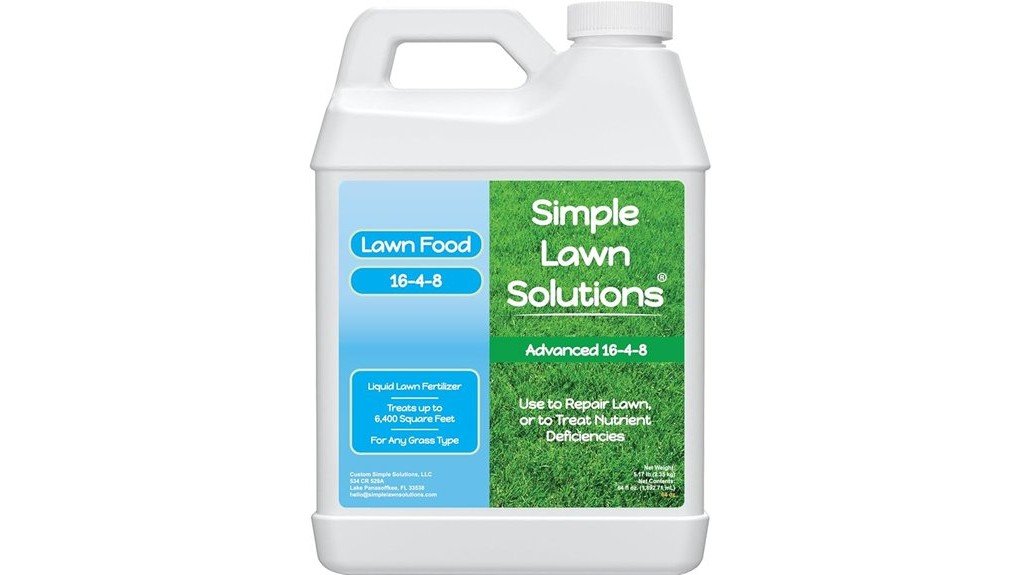
You’ll find Advanced 16-4-8 is a concentrated liquid turf fertilizer (64 fl oz) that mixes at 3 oz/gal and applies 10 oz/1,000 sq ft to treat up to 6,400 sq ft. It delivers 16-4-8 NPK with seaweed and fish emulsion to boost nutrient uptake, chlorophyll, root mass, and microbial activity. Expect visible greening in 7–14 days on common cool- and warm-season grasses. Continue for application tips, performance nuances, and alternatives.
Some Key Takeaways
- Concentrated 16-4-8 liquid feeds established turf with quick greening and vigor, showing visible results in 7–14 days on responsive species.
- Mix at 3 oz per gallon and apply 10 oz per 1,000 sq ft; one 64 fl oz bottle covers up to 6,400 sq ft.
- Seaweed and fish emulsion boost nutrient uptake, root growth, and soil microbiome activity for improved nutrient cycling.
- Best for regular liquid users—cons: requires handling, recurring applications, and careful irrigation to avoid runoff.
- Compare cost per 1,000 sq ft and labor versus granular alternatives and consider mycorrhizal complements for long-term health.
What Advanced 16-4-8 Lawn Fertilizer Is and Who It’s For
Although it’s concentrated liquid rather than granular, the Advanced 16-4-8 Lawn Fertilizer delivers a precise 16-4-8 NPK profile in a 64 fl oz bottle designed for both commercial and homeowner use. You’ll handle a concentrated spray that supplies 16% nitrogen, 4% phosphorus, 8% potassium, plus seaweed and fish emulsion to improve uptake. It covers 6,400 sq ft and mixes at 3 oz/gal; apply 10 oz/1,000 sq ft with a hose-end sprayer. It’s tailored to established turf—urban lawns and common warm- and cool-season grasses—supporting greening, root strength, and measurable drought tolerance gains. This liquid formula is ideal for homeowners looking to transform their lawn with precise, easy-to-apply nutrients.
What’s in the Bottle: Nutrients, Seaweed, and Fish Emulsion Breakdown
Open the bottle and you’ll find a concentrated, measured blend: 16% nitrogen, 4% phosphorus and 8% potassium formulated to drive foliar greening, root establishment and stress tolerance, respectively, with seaweed (kelp) and fish emulsion added to supply trace organics and bioactive compounds that improve nutrient uptake. You’ll see macronutrients calibrated for turf responses; seaweed supplies cytokinins, betaines and alginates, while fish emulsion provides amino acids and soluble organics. Micronutrient analysis supports essential Fe, Mn and Zn availability. The biological fraction fosters beneficial microbial interactions in the rhizosphere, enhancing mineralization and consistent, community-oriented lawn performance. Our product line emphasizes the proven benefits of liquid kelp for homeowners maintaining their lawn and landscape.
How to Use It: Mixing, Coverage, Timing, and Watering Tips
When you’re ready to apply, mix precisely — 3 ounces of concentrate per gallon — to achieve the recommended application rate (10 ounces per 1,000 ft² via hose-end sprayer), which yields uniform nutrient delivery across up to 6,400 ft² from a 64 fl oz bottle; apply in spring, summer, or fall to established warm- and cool-season turfs listed on the label, and water the lawn immediately afterward and keep soil moist for 24–48 hours to promote nutrient uptake and minimize foliar burn. Use calibrated hose-end equipment, follow labeled mixing ratios, stagger applications by season, and prioritize consistent application timing for predictable results. This product is designed specifically for homeowners maintaining their lawn and landscape and complements other foliar spray fertilizers in a seasonal care program.
Real-World Performance: Greening, Growth, Root Health, and Grass Types Tested
Because this fertilizer combines a 16-4-8 NPK with seaweed and fish emulsion, you’ll see measurable changes in turf color and vigor within 7–14 days on responsive species, provided you apply at the recommended 10 oz/1,000 ft² and maintain post-application moisture. You’ll observe rapid chlorophyll increase in Bermuda, Ryegrass, Kentucky bluegrass, and Tall/Fine fescues, with lateral density gains in Zoysia and St. Augustine. Root mass and phosphorus-driven establishment improve, supporting seasonal recovery after stress. Seaweed and fish inputs stimulate the soil microbiome, enhancing nutrient cycling. Data-driven application and consistent irrigation yield reproducible, agronomic-grade results across tested turf. Mycorrhizal inoculants can complement these effects by improving root nutrient uptake and soil structure for long-term turf health.
Should You Buy It? Pros, Cons, Price Value, and Comparable Alternatives
Having seen measurable greening, density, and root improvements on responsive turf within 7–14 days under recommended use, you can now weigh whether Advanced 16-4-8 Lawn Fertilizer fits your lawn program. You’ll appreciate pros: concentrated coverage (6,400 sq ft per 64 fl oz), balanced NPK, seaweed/fish additives, and rapid symptom correction. Cons: liquid handling, recurring applications, and potential runoff risk if misapplied. For cost comparison, calculate cost per 1,000 sq ft versus granular brands and factor labor. Evaluate environmental impact—follow rates and irrigation guidance. Alternatives: similar NPK liquids or granular slow-release formulas depending on persistence needs. This spray-on approach complements homeowner routines for lawn and landscape care and can simplify feeding for those focused on spray-on starter fertilizers.
Some Questions Answered
Is This Fertilizer Safe for Pets and Children After Application?
Yes — you can use the fertilizer, but you should minimize pet safety and exposure risks by following label directions and keeping pets and children off treated turf until it’s dry. The liquid contains soluble nutrients, seaweed and fish emulsion; acute toxicity is low, yet ingestion or dermal exposure to concentrates can irritate. Rinse skin or paws after contact, store product securely, and re-enter only after spray has fully absorbed to reduce exposure risks.
Can I Tank-Mix It With Herbicides or Pesticides?
Yes — you can tank-mix it with many herbicides or pesticides, but you should perform compatibility testing first and respect recommended application timing. Mix small test batches, observe for precipitation, pH shifts, or separation, then evaluate plant safety on a small lawn area. Follow label directions for all products, avoid mixing with incompatible chemistries (e.g., strong acids/alkalis), and space applications as needed to minimize phytotoxicity and guarantee efficacy.
What Is the Shelf Life Once Opened?
You’ll get about 12–18 months of effective storage duration once opened if you keep the concentrate sealed, cool, and out of direct sun. Protect against moisture protection failures by tightening the cap, storing upright, and avoiding temperature extremes; microbial additives (fish/seaweed) can degrade sooner if exposed. You’ll know it’s past prime if odor, separation, or reduced solubility appear. Rotate stock and label opening dates to stay consistent.
Is It Suitable for Organic-Certified Lawns?
No — you can’t count this as organic-certified. It contains synthetic ingredients (the defined NPK formulation) despite added seaweed and fish emulsion, so certifiers would typically exclude it. You can still support soil microbes and lawn health by using it, but if you need formal organic certification you’ll want OMRI-listed or fully natural inputs. You’re part of a group aiming for certified organic turf; choose verified organic products to meet that standard.
Does It Stain Concrete, Wood, or Decking Surfaces?
No — it generally won’t permanently stain concrete, wood, or decking if you follow directions and rinse spills promptly. Controlled staining tests show diluted 16-4-8 residues can darken porous surfaces transiently; thorough washing within 24 hours prevents lasting discoloration. For surface compatibility, avoid prolonged contact on raw wood or untreated concrete, test a small area first, and join others who protect decks and paths by covering or rinsing after application.