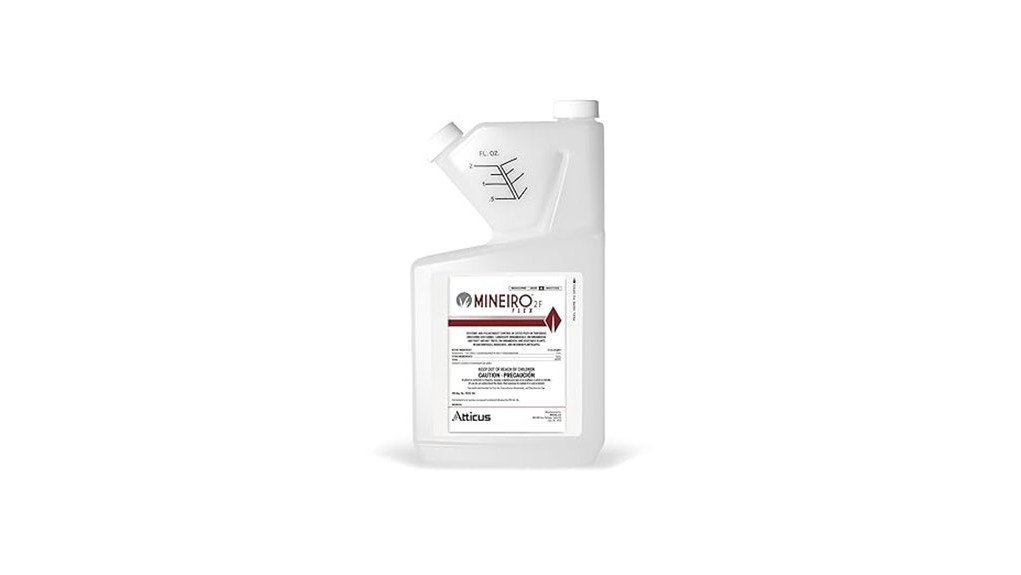
You’ll find Atticus Mineiro 2F Flex (21.4% imidacloprid) gives you a concentrated, long‑residual preventive option for summer‑hatching grubs and many root‑ and leaf‑feeding insects when used exactly as labeled. Apply during the mid‑June to late‑July grub window, calibrate equipment for uniform soil placement, and observe state restrictions and PPE requirements. It’s suitable for turf, ornamentals, and selected fruit/pecan trees but verify local approvals and grazing/harvest limits before use — more practical application and regulatory details follow.
Some Key Takeaways
- Atticus Mineiro 2F Flex is a 32 fl oz, 21.4% imidacloprid liquid concentrate labeled for turf, trees, shrubs, ornamentals, and certain fruit/pecan trees.
- It provides long-lasting soil residual effective for preventive grub control when applied mid-June to late-July.
- Labeled uses include suppression of mole crickets, billbugs, Japanese beetles, emerald ash borer, and aphids when timed before outbreaks.
- Follow label rates, low-pressure coarse spray calibration, irrigation guidance, and PPE, plus check state-specific registration and restrictions.
- Suitable for professionals and informed homeowners; consider IPM integration, resistance rotation, and organic alternatives like nematodes or Bt where needed.
Atticus Mineiro 2F Flex At a Glance: Formula, Uses, and Where It’s Approved
Review the label to apply Atticus Mineiro 2F Flex correctly: this 32 fl oz liquid concentrate contains 21.4% imidacloprid (EPA-registered) and provides preventive control of summer‑hatching grubs and a range of root- and leaf‑feeding insects—mole crickets, billbugs, Japanese beetles, emerald ash borers, aphids—on lawns, trees, shrubs, evergreens, ornamentals, groundcovers, and certain fruit and pecan trees. You’ll find formula specifics, recommended rates, and state registration notes on the label. Pay attention to label nuances that affect use sites and application windows. You’ll also want clear guidance on minimizing environmental impacts and ensuring compliant, community-minded application. Consider integrating timing and scouting into your lawn care routine to maximize preventive grub control.
How Well It Works: Preventive Grub Control and Performance Against Common Pests
Evaluating preventive efficacy, Mineiro 2F Flex delivers targeted control by providing a long‑lasting soil residual of imidacloprid that intercepts summer‑hatching grubs during larval entry and feeding. You’ll achieve consistent preventive timing within the mid‑June to late‑July window to reduce grub establishment and subsequent turf damage. Trials and label guidance indicate reliable suppression of root‑ and leaf‑feeding pests—mole crickets, billbugs, Japanese beetles, aphids—when applied before high populations develop. You’ll also support resistance management by integrating cultural practices and rotating modes of action. The product’s predictable residual action helps you protect turf, ornamentals, and trees with technical confidence. For homeowners maintaining lawn and landscape, pairing treatment with grub control best practices improves overall results and turf health.
How to Apply Mineiro 2F Flex Safely and Effectively (Rates, Timing, and Sites)
How should you apply Mineiro 2F Flex to get effective, compliant results? You’ll measure rates per label for each site — lawns, trees, shrubs, groundcovers, ornamentals — and calibrate equipment for uniform coverage. Apply within recommended grub window (mid-June–late-July) or at first pest detection; use spot treatment timing for localized infestations. Wear required personal protective equipment when mixing and applying. Use low-pressure, coarse droplets for soil/foliar placement; irrigate lightly if label allows to move product into root zone. Record application details, avoid overlapping treated areas, and communicate with team to maintain consistent, documented procedures. Consider integrating systemic insect preventatives into an overall IPM plan to reduce resistance and improve long-term control.
Limitations, State Restrictions, and Label/Regulatory Points to Check
After you’ve established application rates, timing, and protective measures, verify statutory limitations, label-specific restrictions, and state registrations before each use of Mineiro 2F Flex. You should confirm current label updates and note state restrictions that prohibit sale or use in specific jurisdictions. Check federal EPA registration data, local supplemental labels, and any crop- or site-specific limitations. Verify reentry intervals, grazing/harvest restrictions, water protection statements, and tank-mix compatibilities. Keep records of the label version used at application. If in doubt, consult your state lead agency or extension specialist to assure compliance and maintain shared stewardship. Also consider using lockable pesticide storage to secure products and prevent unauthorized access.
Who Should Buy It and Product Alternatives to Consider
If you’re managing turf, ornamentals, or high-value trees and need preventive grub control with a proven imidacloprid formulation, Mineiro 2F Flex is appropriate for users who can comply with label restrictions and state registrations; it suits lawn care professionals, sod growers, and informed homeowners seeking long residual activity against soil- and foliar-feeding insects. You should buy it if you’re a Professional applicator or a Homeowners seeking targeted preventive control and you can observe state exclusions. Consider Organic alternatives (nematodes, Bacillus thuringiensis variants) if you require non-synthetic options. For cost-conscious programs, evaluate Budget friendly substitutes with lower active rates or generic imidacloprid concentrates. Homeowners selecting a pre-emergent should also follow essential tips for timing and application to reduce crabgrass establishment.
Some Questions Answered
Can Mineiro 2F Flex Be Tank-Mixed With Fertilizers or Other Pesticides?
Yes. You can tank-mix Mineiro 2F Flex with some fertilizers and pesticides, but you’ll verify tank compatibility first and follow a strict mixing order. You’ll conduct a jar test to confirm physical compatibility, add water then soluble products, suspensions, emulsions, and finally Mineiro 2F. You’ll avoid incompatible chemistries and follow the product label and local regulations. You’ll document results and only apply mixtures proven safe for your site.
What Personal Protective Equipment Is Recommended Beyond Label PPE?
Wear added protection beyond label PPE: use chemical-resistant gloves, a full-coverage suit, and eye protection; consider a respirator fit-tested to the specific cartridge for particulate/organic vapor exposure. Choose protective footwear—chemical-resistant boots with sealed seams—and wash-off capability. You’ll also want disposable sleeve/boot covers and access to decontamination supplies. Make certain everyone on your team is trained, fit-tested, and included in PPE selection and maintenance procedures for consistent safety.
How Long After Application Is It Safe to Allow Children/Pets Back on Treated Areas?
Wait time and Re entry depend on label-specific directions; typically you’ll wait until spray residues dry and surface residue levels have decreased per label—often 2–4 hours for lawns and treated foliage. You’ll re enter when degradation and drying have reduced exposure risk and label re-entry intervals are met. Follow label for precise timing, restrict children and pets until surface residue is non-detectable or label-specified interval has elapsed.
Does Imidacloprid Affect Pollinators Like Bees and How to Minimize Risk?
Yes — imidacloprid can harm pollinators, causing bee mortality and sublethal effects (navigation, foraging, learning). You should minimize risk by avoiding sprays during bloom, using lowest effective rate, applying in the evening when bees are inactive, employing soil or systemic placements that reduce foliar residues, and notifying local pollinator stewards. Always follow label precautions and coordinate with neighbors to protect community pollinators and maintain shared habitat safety.
What Is the Shelf Life and Proper Storage Temperature for the Concentrate?
You should expect a storage duration of about 2–3 years if unopened and stored properly. Keep the concentrate within a temperature range of 40–90°F (4–32°C), avoiding freezing and excessive heat. Store in original, tightly closed container, upright, in a well-ventilated, dry area away from children, pets, food and ignition sources. Inspect periodically for separation or degradation; if quality changes, follow disposal and label guidance to protect your community.