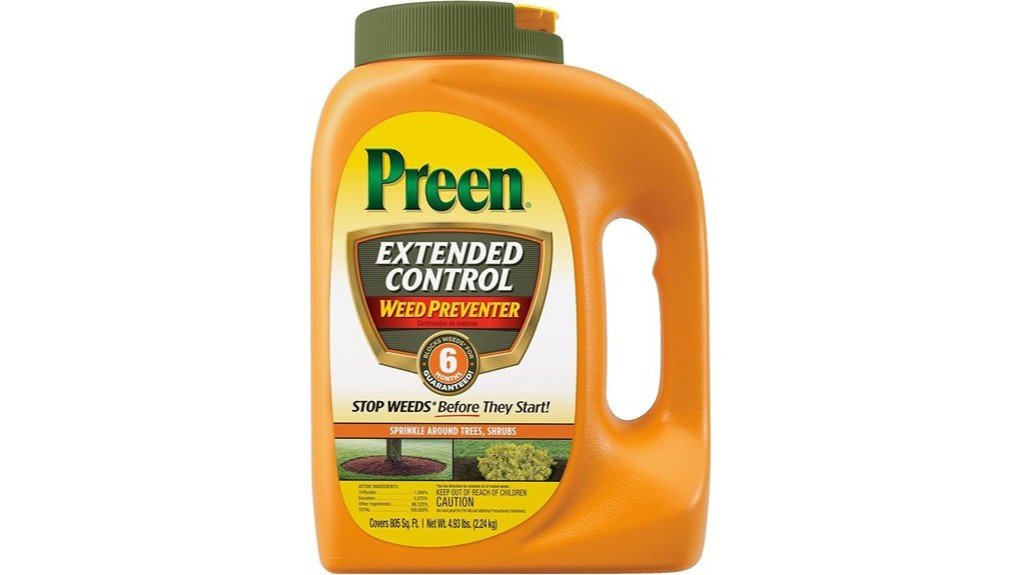
Preen Extended Control gives you long-lasting suppression of weed seeds for up to six months with a single granular application, so you’ll see fewer seedlings and less frequent upkeep. It uses isoxaben and trifluralin to block seedling root and cell development, works only as a preemergent, and won’t kill established weeds. Don’t use it in lawns, seed beds, or edibles and check compatible ornamentals on the label. Keep going to learn how to apply and alternatives.
Some Key Takeaways
- Prevents germination of weed seeds for up to six months when applied correctly as a granular preemergent.
- Active ingredients isoxaben and trifluralin disrupt seedling root and cell development, not effective on established weeds.
- Best for ornamental beds and large areas; unsafe for lawns, seed beds, vegetables, and many seedlings—check label plant list.
- Real-world results show significantly fewer seedlings but variable duration based on season, moisture, and soil conditions.
- Apply to bare or freshly weeded soil with PPE, follow coverage/reapplication rates, and combine with mechanical or nonchemical methods.
Preen Extended Control: Quick Verdict and Who It’s Best For
While it won’t replace spot treatments for established weeds, Preen Extended Control gives you reliable, long-lasting prevention—blocking seed germination for up to six months and protecting beds around hundreds of perennials, shrubs, and groundcovers. You’ll find it best if you want steady suppression with low application frequency and prefer maintaining garden aesthetics without daily upkeep. It’s impartial: one application covers large areas, but it won’t work on lawns, seed beds, or edibles. You’ll belong to a group of gardeners who trade intensive weeding for planned prevention; assess plant lists on the label to make certain it fits your garden. It’s a handy option for homeowners focused on landscape maintenance who want to protect beds from invasive grasses and weeds with crabgrass barriers.
How Preen Extended Control Works and What’s in the Bottle
Think of Preen Extended Control as a preemptive barrier: its active ingredients—isoxaben and trifluralin—target germinating weed seeds so they fail to establish roots, providing up to six months of prevention after a single application. You’ll appreciate that the chemical mechanism interrupts cell division and root development at seedling stages, reducing competition without addressing established plants. The bottle contains granules you scatter around permitted perennials, shrubs, and groundcovers; don’t use near edibles or lawns. Expect labels to note coverage and safety. Consider soil persistence: residues linger long enough to protect beds but follow label intervals to fit your planting plans. Homeowners maintaining lawn and landscape often pair spot treatments with targeted sprayers for best results.
Real-World Performance: Weed Control Results and Duration
Real-world tests show Preen Extended Control delivers reliable suppression of newly germinating weeds for much of its claimed six-month window. You’ll notice fewer seedlings and less weeding chore time across beds and around shrubs when conditions align. Results vary with seasonal variability: wetter springs or warm winters can shorten effective duration, while dry spells may extend it. You should judge success by reduced emergence rather than total absence of weeds. Monitor treated areas and adjust application frequency seasonally if needed to maintain coverage. Overall, it’s a predictable preventative tool when used as part of a consistent garden routine. It works best when combined with non-toxic weed control practices homeowners use to maintain lawns and landscapes.
How to Use It Safely and Effectively (Coverage, Timing, Plants to Avoid)
Because timing and placement determine effectiveness, apply Preen Extended Control as a preventative — not a cure — to bare soil or freshly weeded beds before seeds germinate. You’ll cover up to the labeled 805 sq. ft. per container by following spread rates and doing application calibration so you don’t under- or over-apply. Wear proper PPE during handling and avoid drift to non-targets. Don’t use near flower seeds, lawns, vegetable or other edible plantings; consult the label for the 600+ listed ornamentals that are compatible. Monitor beds after application and reapply per label intervals for seasonal continuity. For best results in an early spring lawn and landscape program, integrate Preen with other weed control practices for a lush, weed-free yard.
Buying Guide: Size, Price, Alternatives, and Where Not to Use
Now that you know how and when to apply Preen Extended Control, consider size, cost, and alternatives to match your garden needs. You’ll find a 4.93 lb granule covering about 805 sq. ft., and different package sizes suit small beds or larger plots; check product codes (Model 2464094, Part 24-64092). Price varies by retailer; compare per-square-foot cost. If you avoid flower seeds, lawns, vegetables, or New York sales restrictions, seek alternatives like corn gluten meal or mechanical weeding. Keep resale options in mind if unused. Join fellow gardeners in choosing what’s right for your space and values. Preen is part of a broader category of lawn and garden products designed for grub control and weed prevention.
Some Questions Answered
Can Pets Safely Access Treated Areas After Application?
You shouldn’t let pets access treated areas until granules settle and label reentry times are met. You’ll reduce pet exposure by keeping animals off treated surfaces during and after application until product has been absorbed or watered in per instructions. If you suspect animal ingestion, contact your veterinarian or a poison control center immediately. You’ll want to follow label directions closely to protect pets and maintain community safety and trust.
Is It Safe to Apply Before Planting Potted Nursery Plants?
Yes — you can apply before planting potted nursery plants if they’re listed on the label; you’ll protect plant safety by preventing weed competition. Don’t use it where seed germination of flowers or edibles is desired, and avoid direct contact with roots or bedding soil for sensitive transplants. Read the approved plant list and directions carefully, follow application rates, and you’ll join others keeping beds weed-free while protecting desired plants.
How Should Leftover Granules Be Stored Long-Term?
Store leftover granules in their original, tightly sealed container in a cool, dry place to make certain proper storage and moisture control. You shouldn’t transfer to damp or open bins; moisture degrades effectiveness. Label the container with purchase date and keep it away from children and pets. You’ll be joining other careful gardeners by following label guidance and checking granules before use; discard if clumped or discolored.
Will It Affect Nearby Edible Gardens Through Runoff?
Yes — you should assume a risk to nearby edibles if runoff reaches them. The product’s drift potential is low with granules and a flip‑top cap, but rain or irrigation can move residues. Because active ingredients have strong soil binding, they tend to stick where applied, reducing long‑distance movement. Still, avoid application uphill or near garden beds, create buffer zones, and follow label instructions to protect communal growing areas.
Are There Restrictions for Commercial Landscaping Use?
Yes — you’ll face commercial restrictions and possible licensing requirements. Check local and state pesticide laws before using this product in commercial landscaping; New York sales are already prohibited. You’ll need to follow label limits on sites, application rates, and approved plant lists, and some jurisdictions require a commercial pesticide applicator license for sale or use. Stay compliant so your team and clients feel included and protected while you work.