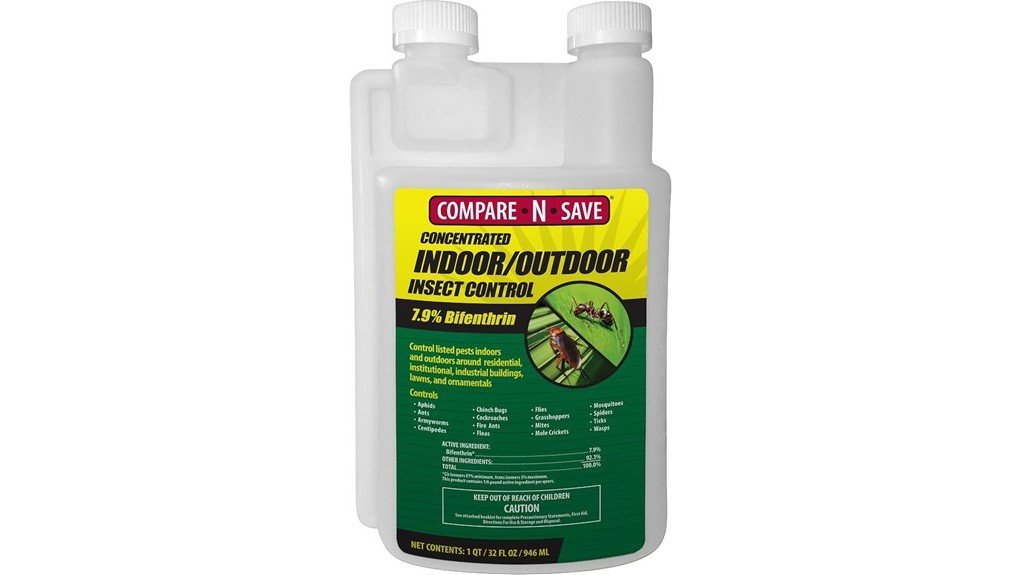
You’ll get a high‑coverage, budget‑oriented concentrate that controls ants, roaches, fleas, ticks, mosquitoes, spiders, wasps, and many lawn pests when mixed per label. You’ll treat ornamentals, trees, shrubs, lawns, and building perimeters with up to 176 gallons of ready‑to‑use spray from a 32‑oz bottle. Mix precisely, use PPE, avoid drift and runoff, and expect fast knockdown on soft pests and multi‑week residuals on turf. Keep going to learn application details and safety tips.
Some Key Takeaways
- Broad-spectrum concentrate effective indoors and outdoors against ants, cockroaches, fleas, ticks, mosquitoes, spiders, wasps, and many lawn pests.
- One 32-ounce bottle dilutes to about 176 gallons, potentially treating up to 176,000 sq ft when mixed as directed.
- Offers rapid knockdown on soft-bodied pests and multi-week residual control on lawns and ornamentals.
- Compatible with tank mixes and IGRs, supporting resistance management and flexible application strategies.
- Requires strict PPE, label/SDS adherence, and drift/runoff precautions to avoid non-target harm and legal issues.
Quick Verdict: Who the 32‑oz Compare‑N‑Save Concentrate Is Best For
If you need broad‑spectrum indoor and outdoor insect control and want a concentrated product that stretches far, the 32‑oz Compare‑N‑Save concentrate is for homeowners, landscapers, and pest‑management pros who treat lawns, ornamentals, and building perimeters. You’ll appreciate its cost efficiency: budget buyers get high dilution yield, reducing per‑acre cost while maintaining labeled efficacy. You’ll also value its versatility for small gardens where precise spot treatments matter. You’ll mix confidently following label directions, and you’ll belong to a pragmatic group that prioritizes scalable, label‑compliant solutions. Use it when you need a dependable, economical broad‑spectrum concentrate. This product is suitable for treating both lawn and landscape areas when applied according to city‑approved pest controls.
What It Controls, Coverage Yield, and Where You Can Use It
Following that quick verdict, let’s look at what the 32‑oz Compare‑N‑Save concentrate actually handles and where you can apply it. You’ll control ants, cockroaches, fleas, ticks, mosquitoes, spiders, wasps, grass pests and many more listed species across ornamentals, trees, shrubs and lawns. The 32‑ounce makes up to 176 gallons of ready‑to‑use spray, covering as much as 176,000 sq ft, so you’ll scale treatments efficiently. Use indoors and outdoors; compatibility with tank mixes and IGRs helps manage pest resistance when integrated into programs. Observe label constraints and ideal application timing to maximize efficacy and community safety. This product is intended for homeowners maintaining lawns and landscapes and is designed for lawn insect control in residential settings.
How to Mix and Apply the Concentrate Safely for Indoor and Outdoor Use
When preparing and applying Compare‑N‑Save Concentrate, read the label and SDS first and wear the recommended PPE—chemical-resistant gloves, long sleeves, eye protection and a respirator if required—then measure concentrate precisely, mix only the amount you’ll use, and use calibrated equipment to guarantee correct dilution for the target site. You’ll follow site-specific dilution rates, observe ventilation requirements indoors, and restrict access until residues dry. For outdoor use, avoid drift and runoff; apply during calm conditions. Store mixed solution temporarily only in labeled containers. Maintain community-minded communication with household or neighbors when treating shared spaces. Consider wearing chemical-resistant gloves specifically designed for lawn and landscape tasks to protect against spills and splashes.
Performance in Real Use: Effectiveness, Speed, and Common Results
After you’ve mixed and applied the product per label and safety guidance, assess real-world performance by measuring knockdown, residual control, and coverage consistency. You’ll observe rapid knockdown time on soft-bodied pests like aphids and fleas, often within hours; harder-shelled insects may take longer. Measure residue longevity by monitoring pest return intervals and surface sampling; expect multi-week suppression on treated lawns and ornamentals when applied correctly. Coverage consistency depends on nozzle choice and agitation during application. You’ll value repeatable results when you follow dilution rates and re-treat schedules, creating a dependable community of informed users. Consider integrating non-toxic grub control practices from eco-friendly lawn care to maintain soil health and protect beneficial organisms.
Pros, Cons, and Buying Considerations (Compatibility, Warranty, and Safety)
Because you’ll weigh effectiveness against safety and compatibility, consider upfront that Compare-N-Save Concentrate delivers broad-spectrum, cost-effective control but requires strict adherence to label directions and appropriate mixing for safe use. You’ll appreciate pros: wide pest spectrum, indoor/outdoor use, tank-mix flexibility, and high coverage per bottle. Cons: toxic if misapplied, potential non-target impact, and limited user-friendly packaging. Before buying, check compatibility with specific additives and plants, review warranty limitations and return policy, and follow storage guidelines, PPE, and SDS instructions. Join fellow users who prioritize responsibility and compliance for reliable results. For homeowners, secure, locked storage for pesticides is recommended to prevent accidental access by children and pets, and to comply with best practices for lockable pesticide storage.
Some Questions Answered
Is It Safe to Use Around Pets Immediately After Application?
No, you shouldn’t let pets return immediately after application; wait until treated areas are dry and ventilated. Follow label-specified application timing and precautions, keep pets confined during spray and until residues settle. Monitor pet behavior for licking, drooling, lethargy or agitation and contact your veterinarian if symptoms appear. Use pet-safe exclusion zones and store concentrate securely. Adhere strictly to label and SDS instructions to minimize exposure and risk.
Can It Be Used in Foggers or Thermal Applicators?
No — you shouldn’t use this concentrate in fogger compatibility or thermal applicator equipment unless the product label explicitly authorizes it. The concentrate’s formulation and carrier rates aren’t validated for aerosolization or heat-based delivery, which can alter droplet size and exposure risk. Always check the label and SDS; if unsure, contact the manufacturer. You’ll keep your team and community safer by following approved application methods and labeled instructions.
How Long Does the Concentrate Remain Effective in Storage?
You can expect good shelf stability for several years if you store the concentrate per label instructions. Keep it sealed, upright, in original container, away from extreme temperatures; maintain recommended storage temperature (cool, dry, above freezing and below excessive heat). You’ll preserve efficacy by avoiding contamination and agitation, checking the SDS/label for expiration or degradation signs. If unsure, test a small diluted batch before wide application to protect your community.
Is There a Childproof Cap or Tamper-Evident Seal?
No—there’s no child resistant closure or tamper indicator on the retail 32‑ounce bottle. You’ll need to store it securely out of reach and follow label storage and disposal instructions. If you want added protection, transfer concentrate only into properly labeled, approved containers with child resistant closures and a tamper indicator, and keep them in locked areas. Contact the manufacturer for confirmation or replacement options if packaging concerns arise.
Can It Be Used on Edible Crops or Vegetable Gardens?
No — you shouldn’t assume it’s safe for edible crops; check the label for explicit edible plant safety and harvest intervals before applying. You’ll need to confirm approved uses, crop-specific directions, application rates, and any pre-harvest interval (PHI). If the label lacks edible-crop instructions, don’t treat vegetables or fruit. Follow label, SDS, and local regulations; contacting the manufacturer or extension service will help you apply safely and stay compliant.