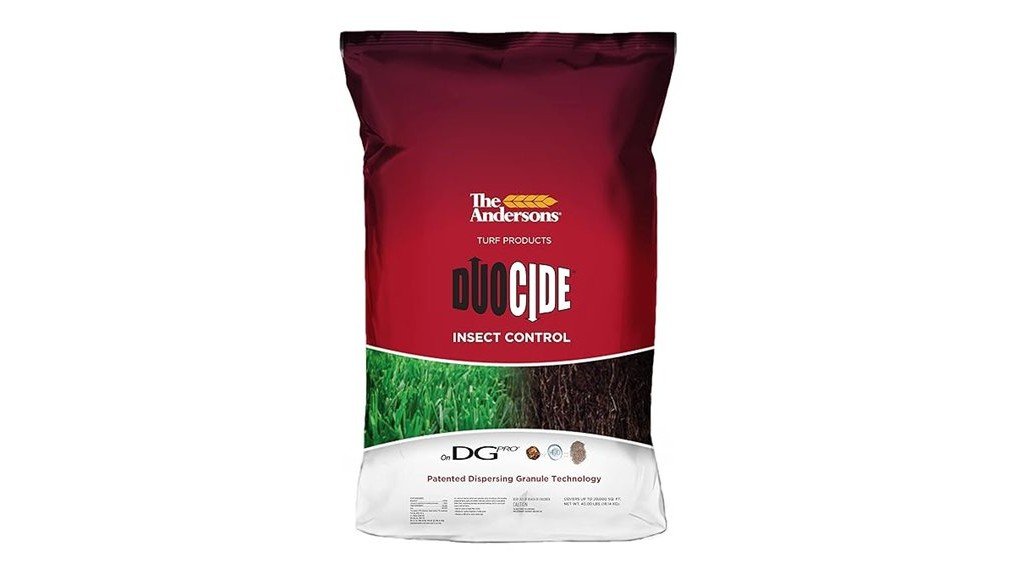
You’ll get professional, dual-action control of common turf pests when you apply Andersons DuoCide exactly per label directions. Its dispersible granules release two actives that move with water, giving surface knockdown for ticks, ants, and fleas while translocating to the root zone to suppress grubs and mole crickets. One treatment covers a large area with predictable release; follow timing, watering, and PPE instructions and rotate modes of action for resistance. Continue for application, safety, and alternatives.
Some Key Takeaways
- Provides reliable, dual-action control of surface pests and subterranean targets like grubs and mole crickets when applied per label.
- Dispersible Granule (DG) technology releases two actives for rapid knockdown and root-zone translocation after watering.
- Effective against grubs, ticks, fire ants, fleas, and mole crickets, with noticeable declines within days after correct timing.
- Requires prompt post-application watering, calibrated spreader use, PPE, and adherence to reapplication intervals for seasonal control.
- Pros: broad-spectrum, cost-effective; cons: environmental concerns, not sold in California, and pet-safety precautions needed.
Quick Verdict : Does Andersons DuoCide Work for Common Lawn Pests?
Usually, yes — Andersons DuoCide delivers reliable control of common lawn pests when applied and watered per instructions. You’ll see rapid knockdown of grubs, ticks, fire ants, mole crickets and fleas after correct application timing, and a single treatment gives dual-action suppression above and below ground. Monitor turf and pest pressure; reapply per label intervals for consistent seasonal efficacy. You’ll appreciate predictable performance and straightforward coverage metrics for planning. Follow safety and local sale restrictions. If you want community-tested results and clear protocols, this product fits a shared standard for effective, professional-grade lawn pest management. Consider integrating systemic insect preventatives into your regular lawn care routine for long-lasting protection.
How DuoCide’s DG Granule Technology Delivers Above‑and‑Below‑Ground Control
When you water DuoCide’s Dispersible Granules (DG), they break down rapidly and release two actives that move with soil moisture, providing contact knockdown on surface pests while translocating into the root zone to reach subterranean targets. You’ll see engineered粒径分布 that optimizes active dispersion; smaller fractions dissolve fast, larger particles sustain release. This promotes predictable soil penetration and minimizes runoff when you follow recommended application timing. You gain both immediate surface control and measured subsurface protection as actives migrate via soil moisture films. The design supports integrated turf programs and invites professional peers to rely on consistent delivery. This performance makes DuoCide a strong option for homeowners seeking effective grub control and professional-grade results.
Real‑World Performance: Effectiveness on Grubs, Ticks, Fire Ants, Mole Crickets, and Fleas
Typically you’ll see rapid knockdown on surface pests and sustained suppression of soil-dwelling targets after a single application of DuoCide DG granules. You’ll notice grubs and mole crickets decline within days as dispersible granules move into the root zone, while ticks, fire ants, and fleas show prompt surface control. Seasonal efficacy hinges on timing and local pest cycles; adjust application frequency to match pressure. For shared practitioners, prioritize resistance management by rotating modes of action and avoiding overuse. Monitor and mitigate non target impacts by following label rates and integrating cultural controls to protect pollinators and beneficials. Homeowners should pair products with proper lawn care practices to maximize long-term pest control and turf health, including cultural controls such as mowing, irrigation, and fertilization.
How to Apply 40 Lb Duocide for up to 20,000 Sq Ft : Timing, Watering, and Safety Tips
Having seen how DuoCide DG performs on both surface and soil pests, you’ll get the best results by matching application timing and watering to pest biology and turf conditions. Apply when insects are active—spring for grubs, late summer for mole crickets—and avoid dormancy. Calibrate spreader for even granule placement across up to 20,000 sq ft. After application, water promptly to activate DG; use short cycles totaling recommended depth—adjust watering frequency based on soil type and recent rain. Wear safety equipment: gloves, long sleeves, eye protection, and a respirator if dusty. Store unused product sealed and away from children and pets. For long-term lawn health, integrate DuoCide use with proper grub control and cultural practices like mowing and fertilization.
Pros, Cons, Alternatives, and Buying Notes (Coverage, Price, and California Restriction)
Although DuoCide DG gives you broad-spectrum control of over 50 turf pests and dual-action suppression above and below the surface, weigh its trade-offs before buying. You get 40 lb covering up to 20,000 sq ft, efficient DG delivery, and single-application convenience. Pros: wide pest spectrum, fast soil activation, cost-per-square-foot value. Cons: not sold in California, potential environmental impact, and granule residues that demand application care for pet safety. Alternatives: targeted baits, biological nematodes, or softer synthetic options. Buying notes: confirm local availability, compare per-square-foot cost, and follow label precautions to minimize risks. Consider integrating biological nematodes into a program focused on sod webworm control to reduce reliance on broad-spectrum synthetics.
Some Questions Answered
Does Duocide Affect Earthworms or Beneficial Soil Organisms?
Yes — Duocide can impact earthworms and microbial diversity if misapplied. You’ll see altered earthworm behavior and reduced surface activity when granules enter their habitat at high doses or without proper watering. Follow label rates and water-in instructions to minimize harm; doing so preserves microbial diversity and supports beneficial soil organisms. You’ll protect ecosystem services best by applying only where needed and avoiding runoff into sensitive areas.
Is This Product Safe to Use Around Edible Gardens or Vegetable Beds?
No — you shouldn’t use it directly in edible gardens or vegetable beds. The product’s dispersible granules and systemic movement pose garden safety concerns; residues can reach root zones and edible tissues. If you must treat nearby turf, maintain a buffer, follow label harvest intervals and withholding periods, and avoid drift or runoff into beds. You’ll protect crops better by choosing insecticides labeled for vegetables or using targeted, organic controls.
Can Duocide Be Applied With a Broadcast Spreader Model X?
Yes — you can apply DuoCide with a broadcast spreader model X if you confirm spreader calibration and nozzle compatibility first. You’ll set the hopper to the product’s recommended output, run a calibration pass over a known area, and adjust settings for uniform granule flow. Check the spreader’s dispersal pattern and any nozzle attachments for DG granules. Work with fellow users or pros if you want shared tips and reassurance.
How Long After Application Can Pets Reenter Treated Areas?
You should keep pets out until granules dissolve and surface residue is dry — typically 24 hours for pet exposure reentry timing. Follow leash protocols when first allowing access, keeping animals supervised and on a short leash to limit contact. If watering occurred sooner or heavy rainfall followed application, wait until soil feels dry and no visible granules remain. Wash paws after initial exposure to reduce residue transfer indoors.
Is There a Specific Storage Temperature or Shelf Life for the 40 Lb Bag?
Yes — you should store the 40 lb bag in cool, dry storage conditions away from direct sunlight and moisture; avoid freezing or prolonged high heat. Keep the bag sealed and elevated to prevent contamination. There’s no specific printed expiration date, but treat product as effective for several years if properly stored; if granules clump or packaging is damaged, consider it degraded. Share storage tips with your group.