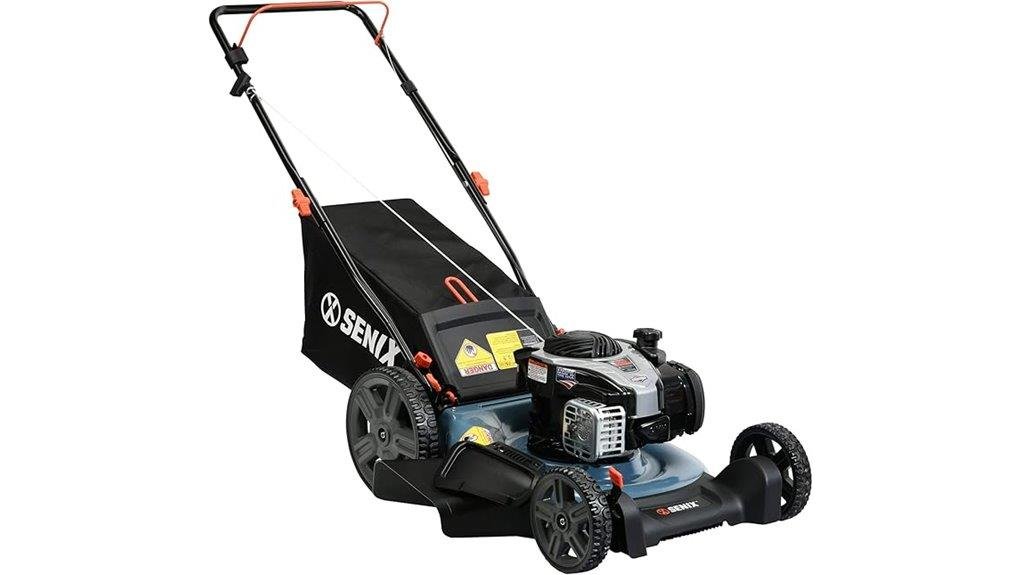
Quick verdict — who it’s for: You’ll like the SENIX LSPG-M7 if you want a dependable, no-frills 21″ push mower that finishes small-to-medium yards without fuss. It comes with a 140cc Briggs & Stratton engine, 16‑gal bag, mulch plug, side discharge, and basic tools, and it starts with a couple tugs, cuts evenly, and steers easily. Expect regular blade sharpening and a bulky bag, but overall it’s solid value for busy homeowners—keep going to get model-specific tips and alternatives.
Some Key Takeaways
- 21-inch steel deck with a 140 cc Briggs & Stratton engine offers reliable, even cutting for small-to-medium yards.
- Includes 16-gallon bagger, mulch plug, side discharge, oil in box, and basic tools for immediate use.
- Prime N Pull typically starts on the 2nd–3rd tug, though wet grass can cause occasional fussy starts.
- Good maneuverability, fuel economy, and ergonomic handle, but blade sharpening is frequently required for clean cuts.
- Affordable 2-year limited warranty and strong value versus branded rivals, though consider battery or self-propelled alternatives for less upkeep.
Quick Verdict: Who the SENIX LSPG-M7 Is Best For
If you’ve got a small-to-medium yard and you want something that’s reliable without being fussy, the SENIX LSPG-M7 is a solid pick — it’s got a 21-inch cutting width and a tried-and-true 140 cc Briggs & Stratton engine, so you’ll cover ground fairly quickly and start the mower without wrestling the cord. You’ll feel like you belong to a practical crew, the kind of neighbors who swap tips, because this mower’s straightforward, dependable, and budget-friendly. For busy homeowners and budget shoppers it’s about steady results, low drama, and getting the job done — progress over perfection. Consider pairing it with essential push mower gear to keep maintenance simple and performance consistent.
What You Get in the Box and Key Specs (Engine, Deck, Weight)
You’ll find everything you need to get this mower running right out of the box, and it’s set up to make the basics painless: the 140 cc Briggs & Stratton 4-cycle engine comes with oil included, so you won’t be stuck hunting for supplies. Quick rundown: box contents include a 16-gallon bagger, mulch plug, side discharge chute, and basic tools, plus cord storage and easy-to-follow papers. The steel deck material gives you 21-inch coverage, strong but manageable, and the 54-pound weight keeps it stable without being heavy. Check wheel bearings and fuel capacity before first use, then enjoy steady progress. This model fits well with homeowners who prefer battery-powered alternatives for maintaining their outdoor spaces.
Real-World Performance: Cutting, Maneuverability, and Start-Up
When you pull the starter for the first time, don’t expect theatrics — the Prime N Pull system usually gets the Briggs & Stratton 140 cc turning on the second or third tug, and that ease of start alone takes a lot of edge off a weekend chore. You’ll notice the cut is even, the 21-inch deck handling rows without fuss, though occasional blade wear shows if you nick hidden debris, so check blades often. Maneuverability feels friendly, the wheels and ergonomic handle help you steer tight beds, and fuel economy is reasonable, so you finish feeling capable, not drained. Consider keeping essential maintenance supplies on hand for better lawn mower care to prolong performance.
Pros and Cons After 60+ Hours of Mixed-Use Testing
After spending over 60 hours mowing everything from thin spring grass to stubborn late-summer clumps, I can tell you what really stood out, what got annoying, and what you can expect day-to-day. Pros: you’ll appreciate steady cutting, easy maneuvering, and solid fuel efficiency that keeps sessions longer, plus handy 3-in-1 options for different needs, and an ergonomic handle that feels like someone thought of you. Cons: you’ll need regular blade sharpening to keep a clean cut, occasional fussy starts in wet grass, and the rear bag can be bulky. Small trade-offs, worth it if you value progress over perfection. For homeowners who take pride in their yard, choosing the right mower blade can make a noticeable difference in cut quality and lawn health, so consider upgrading to quality mower blades that match your mower.
Buying Advice: Price, Warranty, and When to Choose an Alternative
If you’re weighing price and peace of mind, think of the SENIX LSPG-M7 as a solid middle-ground pick: it’s affordable for a 21-inch gas mower, comes with a useful 2-year limited warranty, and includes handy extras like the bagger and oil so you don’t have to hunt for parts right away. In a price comparison, you’ll see it beats many branded rivals on value; still, note warranty caveats, like limited coverage and parts exclusions. If you want less upkeep, quieter operation, or self-propulsion, consider a battery or self-propelled model instead, no shame in choosing fit over fame. This site specializes in helping homeowners find the right self-propelled mower for their yards, with guides on mower selection to match your needs.
Some Questions Answered
Can I Buy Replacement Parts Locally or Only Through SENIX?
You can buy many replacement parts locally, you don’t have to go only through Senix. Check local suppliers and small hardware stores, and talk with independent mechanics who often stock common items like air filters, blades, cables, and oil, or can source them fast. Start by calling a nearby shop, bring your model info, and ask for compatible parts; it saves time, builds community, and keeps your mower running without hassle.
Is the Mower Compatible With Aftermarket Wheel or Handle Upgrades?
Yes — you can fit many aftermarket wheel adapters and handle grips, though you’ll need to check shaft sizes and mounting points first. Heading: quick fit tips. Measure your wheel hub and handle tube, match adapter specs, and pick grips that clamp or slide securely, otherwise you’ll end up redoing it. Cause-and-effect: right parts reduce wobble and fatigue, wrong ones cause repairs. Progress over perfection — start with tested parts, tweak as you go.
What Type of Oil and How Frequently Should I Change It?
You should use SAE 10W-30, check your manual for synthetic vs conventional preference, and change the oil after the first 5 hours, then every 25–50 hours or once a season, whichever comes first. Headline: keep it simple. Use synthetic if you want longer life and better cold starts, conventional’s fine for budget. Change more often if you mow dirty or steep yards. Progress over perfection—stick to a routine and you’ll be fine.
How Loud Is the Mower (dB) During Normal Operation?
You’ll hear roughly 85–90 dB during normal operation, so the sound level is similar to a busy city street, and it’s louder than a lawn trimmer. Noise comparison-wise, expect steady engine roar, with spikes when you accelerate or hit thick grass. You can use ear protection, mow during reasonable hours, and keep the muffler tight to reduce noise, and remember, small changes add up — progress over perfection.
Does the Mower Have a Foldable Handle for Compact Storage?
No, it doesn’t have a true folding mechanism for the handle, but you can tilt it for tighter storage, which helps shrink the storage dimensions a bit. Think of it as a trade-off: you’ll save space, not a ton. If you want easier storing, detach the handle bolts, fold it down, then reattach — it’s doable, a little hands-on. Progress over perfection, right? You’ll get there.