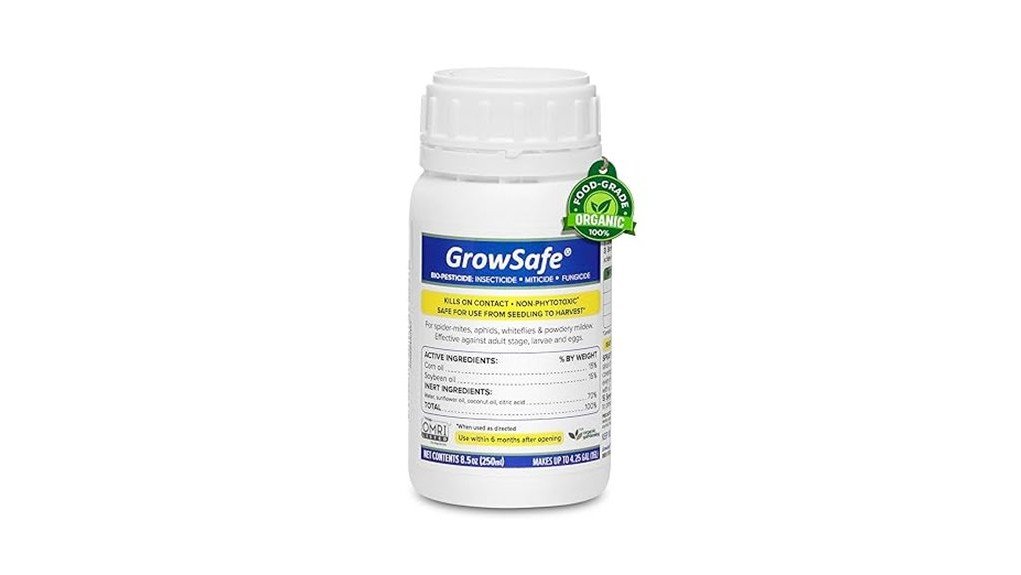
You’ll find AgroMagen GrowSafe is a technically sound, low-residue bio‑pesticide that gives reliable control of two‑spotted, broad and russet spider mites and suppresses whiteflies, aphids and powdery/downy mildews when applied at label rates with thorough coverage. The food‑grade corn/soy oil emulsion mixes well, shows tank‑mix tolerance, and preserves beneficials and crop flavor when used as directed. It’s suited to IPM from seedling to harvest, and the full review explains usage and comparative options.
Some Key Takeaways
- Controls spider mites, suppresses whiteflies and aphids, and delivers rapid contact knockdown of soft-bodied pests.
- Provides curative and preventative control of powdery and downy mildews with low residue persistence.
- Formulated as a stable corn–soybean oil emulsion that mixes readily and remains homogenous in spray tanks.
- Compatible with common fertilizers, biologicals, and beneficial insects, supporting IPM integration when used per label.
- Mid-range-priced 8.5 fl. oz concentrate for small growers, with comparable efficacy to petroleum oils and botanical alternatives.
Quick Verdict: Who Should Use AgroMagen GrowSafe Bio-Pesticide
If you need a non-toxic, food-based oil spray that reliably controls spider mites, whiteflies, aphids and suppresses powdery and downy mildews, AgroMagen GrowSafe is a practical choice. You’ll appreciate its all-natural corn and soybean oil formulation that aligns with organic certification goals and integrates into IPM programs. You can apply it from seedling to harvest without phytotoxicity, and it mixes stably with water for uniform coverage. User testimonials report compatibility with beneficial insects and no off-flavors on produce. Choose it if you want a community-trusted, evidence-based option that’s safe, simple, and technically robust. It’s especially suitable for homeowners seeking eco-friendly fungicide solutions for lawn and garden care.
Does It Work? Efficacy on Mites, Whiteflies, Aphids, and Mildews?
AgroMagen GrowSafe delivers consistent suppression of two-spotted mites, broad and russet mites, whiteflies, and aphids through a unified corn- and soybean-oil formulation that functions as a miticide, insecticide, and fungicide; lab and user reports indicate rapid contact knockdown of soft-bodied pests and reliable reduction in population pressure when applied at recommended concentrations and coverage rates. You’ll observe measurable mite suppression and aphid/whitefly mortality within 24–48 hours; efficacy correlates with thorough coverage and repeat intervals. Field and greenhouse data show curative and preventative activity against powdery and downy mildews. Residue persistence is low, minimizing non-target exposure while maintaining short-term protective activity. Homeowners can integrate GrowSafe use with beneficial nematode applications to enhance overall lawn and landscape pest management beneficial nematodes.
How to Use It Safely and Effectively From Seedling to Harvest
When you apply GrowSafe from seedling through the last day of harvest, follow a consistent, calibrated schedule and precise dilution rates to maximize contact efficacy while minimizing phytotoxicity and non-target exposure. You’ll dilute the oil per label concentrations, apply uniformly with low-pressure sprayers, and record applications to maintain recommended harvest intervals. For seedling application use the lower concentration and shorter spray duration; intensify only after monitoring pest thresholds. Rotate spray timing to avoid residue buildup and protect beneficials. Calibrate nozzle output, wear basic PPE, and document outcomes so your growing community can replicate safe, effective protocols. Always pair these practices with appropriate home mixing safety gear, including gloves and eye protection, and store chemicals securely to prevent accidental exposure to essential safety gear.
Performance Details: Formulation, Plant Impact, and Compatibility
Because the formulation uses a unified, stable blend of food-grade corn and soybean oils, you’ll get a homogenous emulsion that mixes readily with water and maintains consistency without phase separation during typical spray windows. You can expect reliable miticide, fungicide and insecticidal action with minimal residue. Product trials report no adverse effects on vegetative growth or fruit organoleptics; phytotoxicity testing across seedlings to mature plants showed no burn or developmental inhibition when applied per label. Compatibility panels demonstrate tank-mix tolerance with common fertilizers and biologicals. You’ll appreciate predictable performance, safe integration into IPM, and preserved beneficials. For homeowners maintaining lawns and landscapes, using a rain gauge helps ensure applications and irrigation align with local precipitation and avoid overapplication.
Price, Packaging, and Alternatives to Consider
At typical retail pricing for specialty horticultural oils, you’ll find the 8.5 fl. oz (0.53 lb) bottle of GrowSafe positioned as a mid-range, value-focused option for small-scale growers and hobbyists, offering enough concentrate for multiple foliar applications when mixed at label rates. You’ll perform a price comparison against concentrated petroleum-based oils and botanical extracts; GrowSafe often delivers comparable efficacy per treated area at lower environmental cost. Packaging sustainability is moderate: a lightweight plastic bottle reduces transport emissions but lacks recycled-content labeling. Alternatives to contemplate include neem oil and potassium bicarbonate for specific pest–disease profiles and integrated programs. As a product aimed at homeowners maintaining lawns and landscapes, GrowSafe is marketed to be compatible with pet-friendly practices and integrated pest management approaches.
Some Questions Answered
Is Growsafe Bio-Pesticide Omri-Listed or Certified Organic?
No — it’s not listed as OMRI-certified in the provided data. You should verify OMRI status and certification pathways directly with the manufacturer or OMRI database because product metadata here doesn’t indicate an OMRI listing or USDA organic certification. If you need organic approval for market access, request documentation: OMRI listing number, certificate issuer, scope and effective dates. That lets you assess compliance, traceability, and compatibility with your certification pathway.
How Long Does Residue Persist After Application?
Residue typically persists only a few days to a couple weeks; you’ll see rapid breakdown within 3–14 days. Because the oil formulation exhibits limited soil binding and is food-based, microbial degradation predominates, accelerating loss under warm, moist conditions. You’ll reduce residues faster with sunlight, irrigation, and active soil microbiota. Follow label re‑entry and harvest intervals; they’ll reflect conservative margins to protect beneficials and make certain safety.
Can It Be Tank-Mixed With Synthetic Fertilizers or Pesticides?
Yes — you can generally tank-mix it with synthetic fertilizers or pesticides, but you should perform compatibility testing and follow careful application sequencing. You’ll first mix small-scale samples to check stability, pH, and absence of separation or phytotoxicity. Next, apply in the order recommended by labels (typically water, soluble fertilizers, pesticides, then oils), maintaining agitation. This evidence-based approach protects efficacy, crop safety, and fosters confident, collaborative use.
What Is the Shelf Life and Storage Temperature?
Shelf stability is typically 2 years when unopened; once opened, you should use it within 6–12 months for peak potency. Store at room temperature away from direct sunlight; avoid cold storage below 40°F (4°C) because prolonged exposure to cold can increase viscosity and reduce emulsion performance. You’ll want to keep the bottle tightly sealed, upright, and labeled; doing this helps you and your team maintain consistent, evidence-based application results.
Is It Safe for Use on Edible Versus Ornamental Crops?
Yes — you can use it on edible and ornamental crops; its food-based oils minimize human exposure risk and won’t alter fruit taste. You’ll get miticide, insecticide, and fungicide action without harming beneficials. Apply per label from seedling through harvest to protect the soil microbiome and avoid overuse. You’ll follow evidence-based rates and intervals, maintaining crop safety while supporting a community-centered integrated pest management approach.