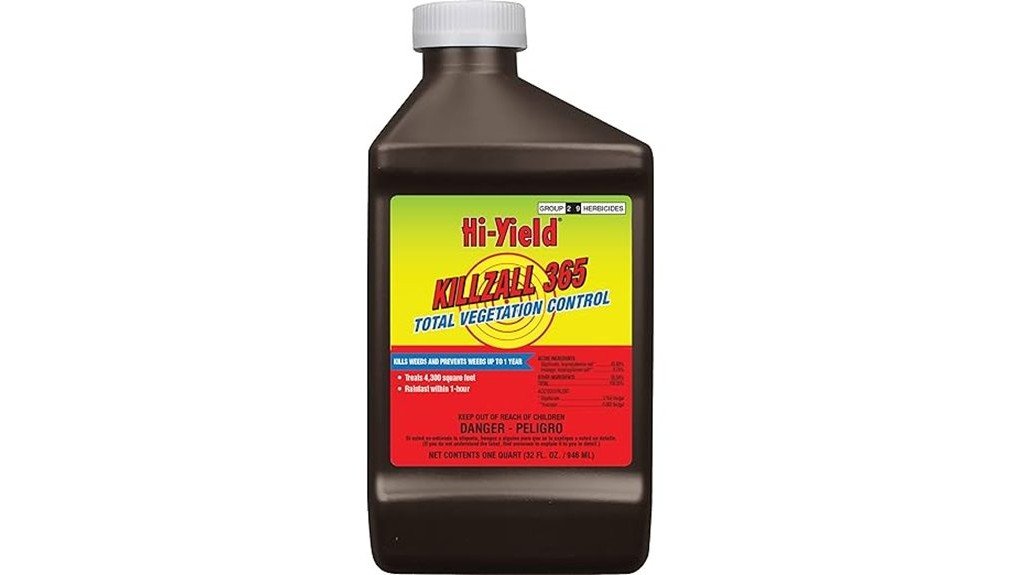
You’ll find Hi‑Yield (32170) Killzall 365 is a concentrated, non‑selective herbicide for non‑crop, no‑vegetation zones that you’ll use for spot or bare‑ground control. Mix 6 oz/gal for spot treatments or 7.4 oz per 1–10 gallons for uniform bare‑ground coverage; a 32 oz bottle makes about 43 gallons of spot spray or treats roughly 4,300 sq ft. It gives fast foliar desiccation on weeds, grasses and young brush; keep PPE on, prevent drift, and continue for full product details.
Some Key Takeaways
- Concentrated 32 oz non-selective herbicide effective on broadleaf weeds, annual/perennial grasses, and woody regrowth in non-crop areas.
- Spot mix is 6 oz per gallon; bare-ground guidance about 7.4 oz per 1–10 gallons for uniform coverage.
- Claims up to ~4,300 sq ft bare-ground coverage per bottle and ~43 gallons finished spray for spot treatments.
- Works quickly for foliar desiccation on dandelion, crabgrass, clover; persistent perennials may need retreatment.
- Requires calibrated sprayer, PPE, drift reduction measures, and following label directions for safety and compliance.
Hi-Yield (32170) Killzall 365 at a Glance: What It Is and Who Should Use It
Although intended for non-crop, no-vegetation areas, the Hi-Yield (32170) Killzall 365 is a 32 oz liquid concentrate herbicide that you’ll use to control broadleaf weeds, grasses, trees, brush, and vines where vegetation removal is required. You’ll find it aimed at target users such as property managers, utility crews, and homeowners maintaining non-lawn zones. Its technical profile—concentrated liquid, broad-spectrum control, coverage up to 4,300 sq ft—defines practical application scenarios: perimeter clearing, fence lines, driveways, and utility rights-of-way. You’ll appreciate clear labeling, measured coverage, and compatibility with standard spray equipment for consistent, repeatable results. Consider integrating eco-friendly pest control practices when planning applications to minimize environmental impact.
How to Mix and Apply Killzall 365 for Spot and Bare-Ground Control
Start by choosing the appropriate mix for the task: for spot control of individual weeds, vines or brush, mix 6 oz of Killzall 365 concentrate per gallon of water; for treating larger bare-ground areas, mix 7.4 oz of concentrate per 1–10 gallons of water and apply uniformly to the target zone. You’ll use the listed mix ratios and follow label limits. Use a calibrated sprayer, wear PPE, and agitate before and during application. Apply when vegetation is actively growing and dry—application timing affects uptake. Treat only targeted non-crop areas, avoid drift, rinse equipment after use, and record treated zones for compliance. Non-selective herbicides are designed for non-crop areas and will damage desirable plants if they contact foliage.
Real-World Performance: What Weeds, Grasses, Brush, and Vines It Actually Kills
When used at labeled rates, Killzall 365 delivers reliable control of a wide range of broadleaf weeds, annual and perennial grasses, and woody brush and vines common in non‑crop, no‑vegetation zones. You’ll observe rapid foliar desiccation on dandelion, clover, plantain, crabgrass, foxtail, and other common species. It reduces sap flow in young woody stems and top‑kills multiflora rose, kudzu shoots, and blackberry canes when applied directly. Perennial toughies like quackgrass and bindweed need thorough coverage and may require retreatment; expect reduced vigor rather than immediate eradication. Control of woody regrowth is improved with cut‑surface or higher‑rate applications. For homeowners managing turf and landscapes, integrating grub control into an overall pest-management plan helps preserve lawn health while targeting non‑crop vegetation.
Safety, Coverage, and Cost Efficiency: How Much 32 Oz Treats and What to Expect
Because Killzall 365 is a concentrated formulation, a single 32 oz bottle can treat large areas efficiently: at the label rates, 32 oz makes up to roughly 43 gallons of finished spray for spot treatments (6 oz/gal) and up to about 4,300 sq ft of bare-ground control with the higher dilution guidance (7.4 oz per 1–10 gal applied as directed), so plan mixes and application passes to match the target density and expected regrowth. You should wear personal protective equipment per label. Estimate cost per treated area by dividing bottle price by covered sq ft. Follow label directions to limit environmental impact and guarantee repeatable, compliant results. For best results when treating lawns and landscapes, consider pairing the product with an appropriate fungicide sprayer designed for home lawn care to ensure even coverage and correct dilution.
Common Problems and Troubleshooting: Poor Results, Drift, and Application Tips
Although you followed label rates, poor control often comes from incorrect mix, spray technique, or timing, so check those first. You should verify concentrate-to-water ratios (6 oz/gal for spot, 7.4 oz for bare-ground mixes) and maintain nozzle calibration. Reduce spray drift by using low-drift nozzles, lower pressure, and coarse droplets; avoid windy conditions. Observe application timing—treat actively growing weeds and avoid drought-stressed or frosted plants. For persistent regrowth, retreat per label intervals. Wear appropriate PPE, shield desirable vegetation, and document conditions. If results still fail, consult the label or contact manufacturer for diagnostics and batch clarification. Protect your lawn by choosing effective crabgrass barrier products designed for homeowners who maintain their lawn and landscape.
Some Questions Answered
Can Killzall 365 Be Used Near Edible Crops or Gardens?
No, you shouldn’t use Killzall 365 directly in edible gardens or next to crops where food will be harvested; it’s formulated for non-crop, no-vegetation areas. You’ll protect edible safety by keeping treated zones separate, avoiding drift, and thoroughly rinsing any equipment. Follow label planting intervals and restrictions before planting nearby edibles. If unsure, choose a product specifically labeled for use around food crops or consult local extension guidance for safe timing.
How Long After Application Can Pets Return to Treated Areas?
Wait until treated areas are fully dry before letting pets back; that minimizes exposure and follows typical reentry interval guidance. You’ll generally wait several hours to a full day depending on weather, application rate, and surface. Keep pets off treated zones until no wet residue remains and label reentry interval instructions are met. You’re protecting pet safety and respecting specific label reentry interval directions for safe use and peace of mind.
Is This Product Compatible With Surfactants or Adjuvants?
Yes — you can use surfactant compatibility and adjuvant interactions with this concentrate, but you’ll follow label directions. You’ll add approved nonionic surfactants for improved wetting on tough broadleaf weeds and grasses; avoid incompatible oil-based adjuvants unless label permits. You’ll test mixes on a small area first, observe for phytotoxicity, and maintain recommended concentrations and equipment cleanliness to guarantee consistent performance and shared safety among your group.
What Is the Shelf Life Once the Bottle Is Opened?
You’ll generally get about 1–2 years as an expiration timeframe once opened, provided you follow recommended storage conditions. Keep the concentrate tightly sealed, stored upright in a cool, dry place away from heat and direct sunlight, and avoid freezing. If the mix shows separation, precipitate, off-odors, or reduced performance, discard it. You’ll protect efficacy and stay safe by labeling opening date and inspecting before each use.
Can Killzall 365 Be Used Through Backpack Sprayers or Wands?
Yes — you can apply Killzall 365 through backpack sprayers, wands, and many handheld sprayers if you follow label rates and equipment specs. Don’t use pressure washers; they’re not designed for herbicide metering and can aerosolize product. Calibrate flow, use proper nozzle, maintain recommended dilution (6–7.4 oz/gal per spot or bare-ground directions), wear PPE, and rinse equipment after use so the group you’re with stays safe and effective.