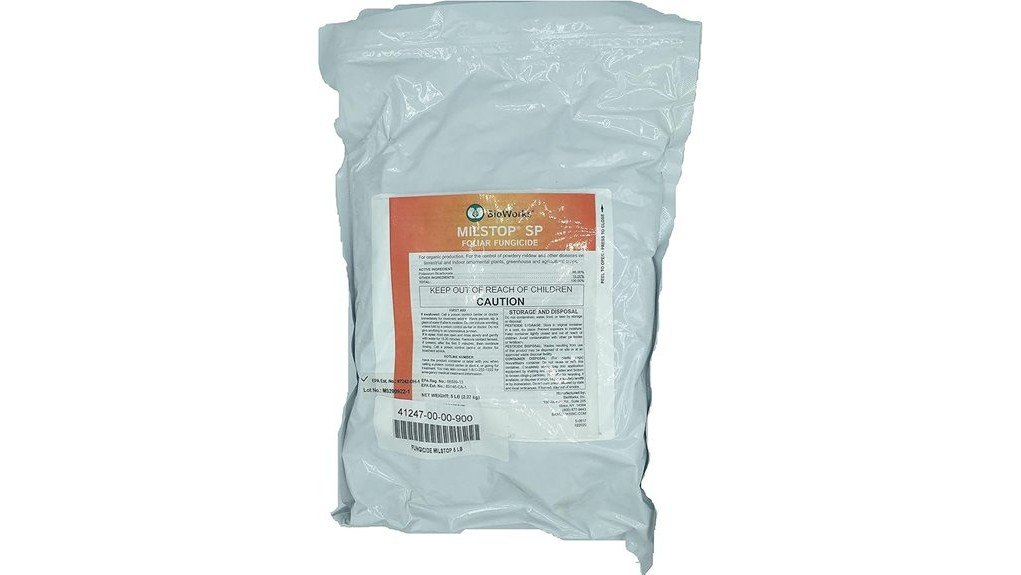
MilStop SP is an OMRI-listed potassium bicarbonate water-soluble powder you’ll use as a rapid foliar treatment for powdery mildew and many other foliar fungi (Alternaria, Botrytis, Cercospora, Septoria, downy mildew). Lab and field data show quick knockdown, residual protection, low phytotoxicity when mixed and applied per label, and no documented resistance. It’s pre-formulated with a spreader-sticker for uniform coverage and IPM compatibility; continue for mixing, timing, and purchasing details.
Some Key Takeaways
- OMRI-listed potassium bicarbonate powder that quickly suppresses and prevents powdery mildew on ornamentals, houseplants, and greenhouse crops.
- Pre-mixed with spreader-sticker; water-soluble bag dissolves cleanly for even foliar coverage and fast knockdown.
- Controls multiple foliar fungi (Botrytis, Alternaria, Septoria, Anthracnose, downy mildew) with low phytotoxicity when used as directed.
- Low mammalian toxicity, compatible with IPM and beneficial insects, and suitable for organic certified programs.
- Cost-effective concentrated format in 5 lb bags with strong user ratings, but check local availability and label application limits.
What MilStop SP Is and What It Treats
MilStop SP is a water-soluble potassium bicarbonate powder formulated by BioWorks, Inc. to kill and prevent powdery mildew and control a range of foliar fungal diseases, including Alternaria blight, Anthracnose, black spot, Botrytis blight, Cercospora and Septoria leaf spots, downy mildew, and Phomopsis blight. You’ll use MilStop SP Organic Foliar Fungicide as a technical, OMRI-listed option for houseplants, ornamentals, and greenhouse applications. It provides rapid foliar protection, dries cleanly, and integrates with IPM without known resistance. Directions and spreader-sticker formulation support consistent coverage, helping maintain plant health and enhance garden aesthetics. It is a suitable choice for homeowners seeking organic fungicide solutions to boost lawn and landscape health.
How Effective Is MilStop SP Against Powdery Mildew and Other Diseases?
Frequently, you’ll find MilStop SP highly effective at rapidly suppressing and preventing powdery mildew on treated foliage; its potassium bicarbonate action disrupts fungal cell walls and creates an inhospitable leaf surface, delivering quick knockdown and residual protection when applied according to label rates. You’ll also get control or suppression of diverse foliar pathogens (Alternaria, Anthracnose, Botrytis, Septoria, Cercospora, downy mildew) in ornamentals and greenhouse settings. Field and greenhouse reports show consistent performance with low phytotoxicity when used properly. Integrate MilStop SP into resistance management programs, rotate modes of action, and respect application timing to maximize efficacy and community trust. It is well suited for homeowners seeking eco-friendly fungicide options for lawn and garden care.
How to Mix and Apply MilStop SP for Best Results
Usually, you’ll prepare MilStop SP as a water-soluble suspension at label-specified concentrations, measuring the powder precisely, pre-dissolving in a small volume of warm water, then adding to the remainder of the spray tank while agitating to guarantee uniform dispersion. You’ll follow published mix ratios (gallon/L) for target crops and disease pressure, calibrate your sprayer, and apply complete canopy coverage. Application timing is critical: start at first symptom or preventatively and reapply at label intervals, avoiding heat-stress periods. Record batches, environmental conditions, and outcomes so your team can refine rates and timing based on measured efficacy. Consider using eco-friendly alternatives when integrating fungicides into child-safe lawn and garden programs.
Safety, Organic Credentials, and Compatibility With Beneficial Insects
Because it’s OMRI Listed and uses potassium bicarbonate as the active ingredient, you can expect a low-toxicity profile suitable for certified organic programs and many IPM systems. You’ll find Organic certification documented on labels and manufacturer literature, supporting use in certified production. Toxicological data indicate low mammalian toxicity and rapid environmental breakdown. Field and lab observations report no known resistance to MilStop SP. Formulation is pre-mixed with spreader-sticker, reducing application variability. Importantly, trials and manufacturer guidance show Beneficial compatibility with most predatory insects and parasitoids when applied as directed, allowing you to integrate MilStop into conservation biocontrol. The product is offered by a company that specializes in quick-green liquid formulas for homeowners who maintain their lawn and landscape, emphasizing ease of use and eco-friendly application practices quick-green liquid.
Buying Details, Packaging, Availability, and Value Verdict
With a single 5 lb (80 oz) water‑soluble bag, MilStop SP gives you a concentrated, OMRI‑listed potassium bicarbonate fungicide that’s pre‑formulated with a spreader‑sticker and intended for repeated foliar treatments in greenhouses, ornamentals, and houseplant production. You get one bag per unit; it dissolves cleanly and applies evenly. Availability is broad but note shipping restrictions — not sold in Washington, DC per source — so verify retailer coverage. Cost comparison shows favorable per‑acre/liter economics versus ready‑to‑use sprays, especially if you dilute for repeated use. Given efficacy, organic status, and 4.5‑star reviews, value is strong. It’s a product commonly offered by retailers specializing in systemic fungicides and homeowner lawn and landscape supplies.
Some Questions Answered
Can Milstop SP Be Used on Edible Crops Like Herbs and Vegetables?
Yes — you can use MilStop SP on edible herbs and vegetables; it’s OMRI-listed, showing organic compatibility, and formulated with potassium bicarbonate. You should follow label directions, rinse produce if concerned, and observe application timing to avoid harvest intervals and heat stress. You’ll protect crops from powdery mildew and similar pathogens while preserving beneficial insects when applied as directed, fostering shared stewardship among growers and home gardeners.
How Long After Application Can I Harvest Treated Edible Plants?
You can generally harvest treated edible plants immediately after application; MilStop SP has no required minimum interval and harvest timing is effectively immediate for most herbs and vegetables. Use label directions and organic standards as your evidence-based guide: rinse produce if desired, avoid applications during heavy rain, and respect any crop-specific notes. You’re part of a community practicing safe, compliant use—check local regulations and the product label for final confirmation.
Can Milstop SP Be Tank-Mixed With Fertilizers or Other Pesticides?
Yes — you can tank-mix MilStop SP with many fertilizers and pesticides, but you should perform compatibility testing first. Mix small proportions in a jar, observe for separation, precipitation, or pH shifts. Respect application timing: avoid combining with highly alkaline or oil-based materials and don’t apply immediately before/after systemic pesticides without label guidance. If unsure, run a field phytotoxicity trial on representative plants to confirm safety and efficacy.
Does Milstop SP Leave Any Visible Residue on Plant Surfaces?
You generally won’t see visible residue on plant surfaces after MilStop SP dries; it’s formulated to dry quickly and cleanly. You’ll notice no altered surface texture on leaves when mixed and applied per label, though high rates or hard water may leave slight whitish deposits that wipe off. Follow dilution and application guidance to minimize buildup; tests and user reports indicate minimal residue and preserved foliar feel, compatible with beneficials.
What Storage Conditions and Shelf Life Does the Product Have?
Store at cool, dry conditions—avoid freezing and temperatures above 86°F; maintain packaging integrity to preserve efficacy. You’ll keep the water-soluble powder stable when the bag stays sealed, dry, and away from direct sunlight and moisture. Under proper storage temperature and intact packaging integrity, expect normal shelf life consistent with manufacturer guidance; if bag is compromised or exposed to humidity, discard to protect your plants and community’s trust in treatment.