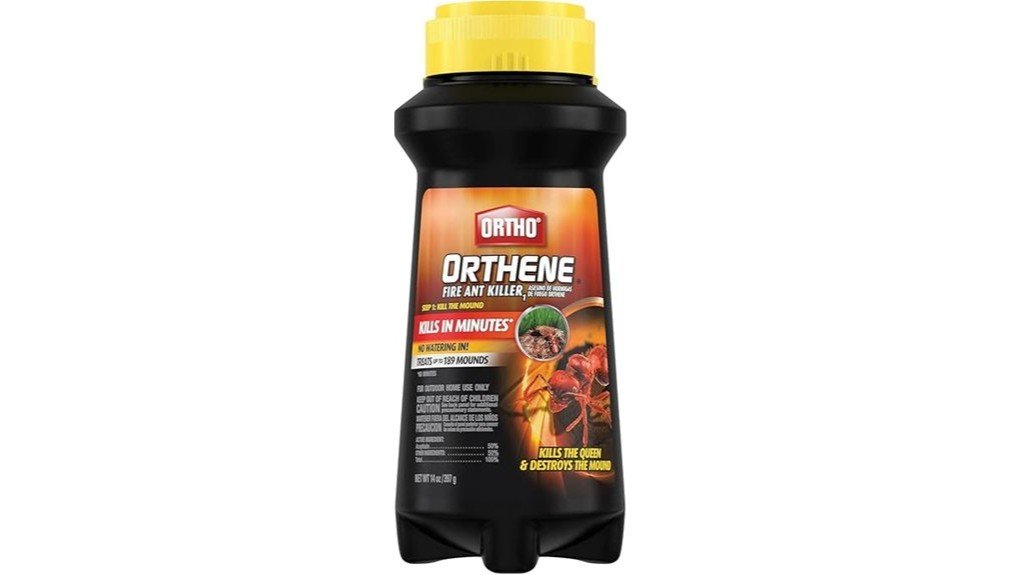
You’ll get a professional-strength, acephate-based granular product that penetrates mounds to contact and kill workers and the queen. Apply about 1 tablespoon per dry mound with the shaker top during morning or evening foraging, wear gloves and eye protection, and avoid inhaling dust. Workers die quickly and mounds usually collapse within one to three days; granules resist typical rain and no watering is needed. Continue for details on application nuances and long-term control.
Some Key Takeaways
- Professional-strength acephate granules penetrate mounds quickly to kill workers and the queen, offering fast colony collapse within 1–3 days.
- Apply about 1 tablespoon per dry mound using the shaker top during morning or evening forager activity.
- Workers die on contact and activity typically drops within 24–72 hours; reapply only if activity persists after 7–10 days.
- Granules are rain-resistant (no watering required) and also affect other ant species and select cockroaches and termites on contact.
- Use protective gear, avoid disturbing mounds, inspect for satellite colonies, and integrate perimeter treatments for long-term control.
How Ortho Orthene Fire Ant Killer Works and What It Treats
Ortho Orthene Fire Ant Killer uses the organophosphate acephate in a professional-strength granular formula that penetrates fire ant mounds, contacts and kills worker ants and the queen, and thereby destroys the colony. You’ll apply 12 oz bottles of powder/granules designed to reach brood chambers; acephate’s chemical mechanism inhibits acetylcholinesterase, causing rapid neural failure in targeted ants. The product treats fire ants primarily but also affects sugar, red and black ants, plus select cockroaches and termites when directly contacted. You’ll appreciate clear instructions and community-tested efficacy, while evaluating non targets impact and following stewardship to minimize unintended exposures. It is intended for homeowners who maintain their lawn and landscape and should be used following label directions to reduce risks to non-target wildlife.
Quick Setup: When and How to Apply the Granules Safely
Having understood how the acephate granules penetrate mounds and neutralize colonies, you’ll prepare for application by choosing the right time, equipment, and dose to maximize efficacy while minimizing exposure. Schedule morning application or late evening when foraging is active. Wear protective gear: gloves, long sleeves, and eye protection; avoid inhalation. Use the built-in shaker top to dispense approximately 1 tablespoon per mound onto dry surfaces; do not disturb the mound beforehand. Maintain a safe distance after application. Store unopened bottles securely. Work alongside neighbors when treating shared areas to reassure consistent coverage and community-level control. For best long-term results, integrate grub control with broader lawn and landscape maintenance practices.
Real-World Performance: Speed, Rain Resistance, and Colony Control
You’ll see colony decline quickly after applying the acephate granules: workers die on contact and activity around the mound typically decreases within hours, with most mounds showing substantial collapse over one to three days as the formulation penetrates to the queen. You’ll observe rapid knockdown in treated mounds; counts drop markedly within 24–72 hours. The granules are rain-resistant, so performance isn’t compromised by typical showers and you won’t need post-application watering. For sustained suppression, the product delivers long term efficacy when used per directions and integrated with follow-up perimeter treatments, enabling consistent yard protection for your community. Proper timing and integration with grub control practices can help maintain a lush, healthy lawn.
Comparing Ortho Orthene to Other Fire Ant Killers
After observing rapid colony decline with acephate granules, it helps to compare that performance and features against other fire ant treatments so you can choose the best option for your situation. You’ll note Ortho Orthene’s acephate-based granules deliver fast mound penetration and queen elimination versus slower bait systems that rely on forager transfer. In brand comparison, Ortho’s professional-strength profile and multi-pest utility distinguish it from consumer-level baits and contact insecticides. Evaluate cost effectiveness by comparing upfront unit cost, treated-mound yield, and residual needs; Ortho’s targeted single-mound application can lower total treatment frequency in high-density infestations. Homeowners should consider mound-focused applications when choosing products for effective lawn insect control.
Tips, Dosage, and Troubleshooting for Best Results
When treating fire ant mounds with Ortho Orthene Fire Ant Killer, apply precisely 1 tablespoon of granules to each dry mound using the shaker top, ideally in the morning or late evening when ants are active, and do not disturb the mound before or after application. You’ll follow safety precautions: wear gloves, avoid inhalation, keep children and pets away, and store bottles securely. For dosage, treat each visible mound individually; reapply only if activity persists after 7–10 days. For mound maintenance, inspect regularly, address satellite colonies, and integrate broadcast granules for perimeter control to prevent reinfestation. Consider integrating space-saving hose reels into your yard layout to maximize lawn space and simplify maintenance.
Some Questions Answered
Is This Safe for Pets and Children After Application?
No — you shouldn’t let pets or children enter treated areas until the product settles and granules are no longer visible. For pet safety, keep animals and kids off treated lawns and patios during application and until dry; reentry timing typically means once granules are dispersed and there’s no residue, often a few hours. Follow label instructions precisely, store containers securely, and contact Poison Control for exposure concerns to maintain community safety.
Can Acephate-Treated Areas Be Used for Edible Gardening?
No — you shouldn’t plant edibles immediately in acephate-treated areas. Acephate residues can persist in soil; follow label intervals before planting food crops. For safe reuse, perform soil remediation measures (remove topsoil, compost dilution, or monitored biodegradation) and implement crop rotation with non-edible cover crops to reduce residue risk. Test soil for pesticide levels before establishing vegetables, and consult local extension guidelines to confirm appropriate waiting periods and remediation steps.
How Should Unused Granules Be Stored and Disposed Of?
Store securely in its original, tightly sealed container, in a cool, dry, locked area away from children, pets, food and livestock feed; label and date opened bottles. For disposal, follow local hazardous-waste regulations: contact your municipal waste authority or hazardous-waste facility for guidance and drop-off. Do not pour granules into drains or trash receptacles. You’ll guarantee community safety and regulatory compliance by disposing properly and documenting the disposal method.
Does This Product Have an Odor During or After Application?
Yes — you may notice a mild chemical scent during application that fades afterward. You’ll detect acephate-associated odors briefly, which are typically low-intensity and short-lived. Some people with sensitivities might experience temporary irritation (eyes, throat, or skin) if exposed directly; wear gloves and avoid inhaling dust. You’ll belong to a group who prefers using protective gear and applying outdoors when ants are active to minimize exposure and odor persistence.
Are There Any Restrictions for Use Near Water Bodies or Beehives?
Yes — you should avoid applications near water bodies and beehive proximity. You’ll keep at least the label-specified buffer from ponds, streams, wells and drainage to prevent runoff and aquatic exposure. Maintain distance from active beehives and flowering plants to minimize bee contact; apply when bees are inactive. Follow all label restrictions and local regulations, use minimal effective amounts, and notify neighbors with hives so you’re acting responsibly and inclusively.