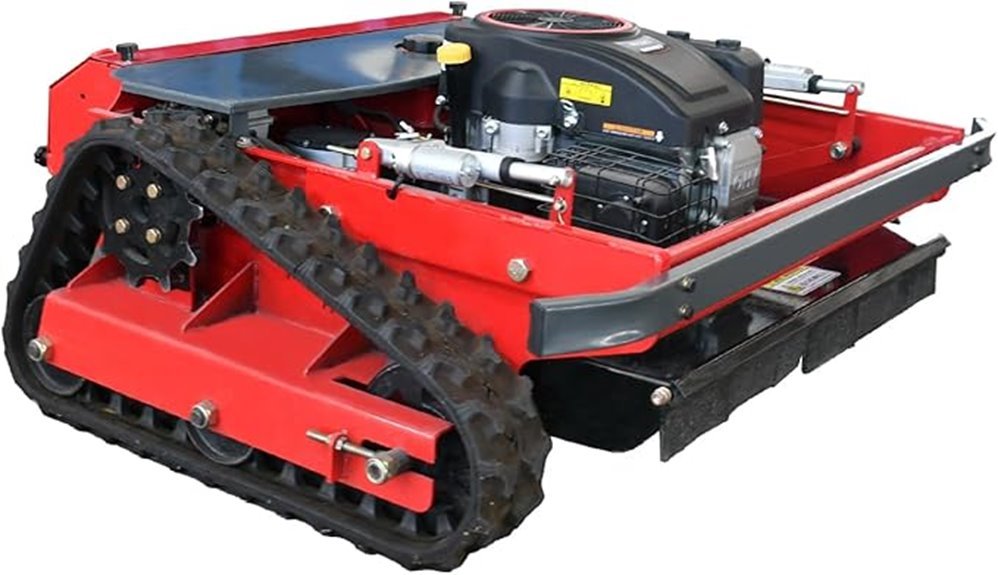
You’ll get a heavy-duty, remote-operated mower with a true 31.5-inch swath, dual rubber caterpillar tracks, and a 224 cc engine that keeps torque on mud, gravel, and steep slopes up to a rated 50°. It’s built for acreage, embankments, and inaccessible plots where crew safety matters; top speed is about 3 mph with practical throughput near 1.2 acres/hour. Remote range is advertised to 1,650 ft and includes an emergency-stop; keep going and you’ll see detailed trade-offs and ownership notes.
Some Key Takeaways
- Heavy-duty remote mower with a true 31.5 in cutting swath suits large properties and reduces number of passes.
- Dual rubber caterpillar tracks and 224 cc engine provide traction and power for steep, rough, or muddy terrain.
- Anti-roll sensors, mechanical interlocks, and 50° rated slope handling prioritize operator and crew safety.
- Remote range up to 1,650 ft with emergency-stop and onboard kill switch; verify real-world responsiveness near obstacles.
- High throughput (~1.2 acres/hour ideal) and robust build lower downtime but require maintenance and warranty/service checks.
Quick Verdict: Who Should Buy the 31.5 Remote-Controlled Mower
If you need a heavy-duty, remote-operated mower for large or steep properties, this 31.5-inch model is built for the job: it combines a 224 cc engine, dual rubber caterpillar tracks, and an anti-roll system to handle rough terrain and slopes up to 50°, while remote control (up to 1,650 ft) and an emergency-stop feature let you work from a safe distance. You’ll want this if you manage acreage, steep embankments, or inaccessible plots and value crew safety. It preserves gardening aesthetics with uniform cuts and adjustable height, though you should weigh engine noise levels against operational gains. It’s for practical teams. Elevate your outdoor gear with the right mower lift by choosing accessories that match your terrain and maintenance needs, including mower lift options for safer service and storage.
How the Mower Performs: Cutting Width, Speed, and Throughput Tested
From the overview of who should buy this unit, let’s measure what it actually delivers on the ground: cutting width, travel speed and hourly throughput. You get a true 31.5 in swath that reduces passes; blade balance is solid out of the box, minimizing vibration and improving cut consistency. At its top travel speed of 3 mi/h the unit sustains an effective mowing throughput near 21,500 sq ft/hour in open turf. You’ll notice controlled acceleration and modest noise levels compared with petrol push mowers. In practice you cover about 1.2 acres per hour under ideal conditions. This model is well suited for homeowners who appreciate efficient cordless solutions and well-maintained outdoor spaces, reflecting the focus on cordless mowers for easier yard care.
Terrain and Safety: Tracks, Slope Handling, and Anti-Roll Behavior
When you need reliable traction on uneven ground, the mower’s dual rubber caterpillar tracks deliver consistent grip and flotation across mud, gravel, and rough turf. You’ll appreciate track durability designed for high-intensity work; reinforced treads resist abrasion and reduce downtime. The system gives excellent terrain grip on varied surfaces and maintains forward progress at the rated 3 mi/h. Anti-roll sensors and mechanical interlocks engage on inclines up to 50°, so you can position the unit remotely with confidence. Controls prioritize stability: gradual acceleration, automated braking, and center-of-gravity management that keep the mower predictable and safe. Many homeowners who enjoy their outdoor spaces pair these capabilities with complementary accessories for a complete robotic mower lifestyle.
Remote Control, Range, and Emergency-Stop Usability in Real Conditions
Beyond traction and slope management, you’ll want to verify how the remote system performs under real-world conditions: range, responsiveness, and emergency-stop reliability matter more than lab specs. You’ll test the advertised 1,650 ft range across typical yard layouts, noting where signal interference crops up near structures or tree lines. Confirm responsive controls at working speed and that the emergency-stop cuts power instantly from the controller and onboard kill switch. Monitor battery life under continuous remote use and reserve for safety margin. Share findings with fellow owners so you all trust remote handling before you run challenging jobs. Also consider how battery solutions affect run time and reliability in outdoor battery-powered equipment.
Buy or Skip? Cost, Durability, Service, and Final Recommendation
If you’re weighing whether to buy or skip, focus on total cost of ownership, expected uptime, and how responsive service actually is. You’ll value the robust build and steel blade for long service intervals; tracks and anti-roll design lower downtime on slopes. Check warranty terms and confirmed 24-hour support response — that matters for fast fixes. Measure battery life against your acre needs and note noise levels when operating near neighbors. Consider resale value: durable components retain more. Buy if you need high throughput and reliable remote safety; skip if you want lowest upfront price or minimal maintenance responsibility. Also consider whether a self-propelled mower design better fits your yard and maintenance habits.
Some Questions Answered
Does the Mower Work in Wet or Rainy Conditions?
Yes — you can use it in wet or rainy conditions within limits. You’ll get reliable water resistance and traction control from the dual rubber caterpillar tracks and sealed components, so you’ll feel secure operating on damp turf and slopes up to 50°. Don’t push it through deep standing water or storm conditions; stop if sensors or cutting performance degrade. You’ll also appreciate remote emergency stop and the manufacturer’s support if issues arise.
How Long Is the Engine Runtime per Tank?
You’ll get roughly a 1.5–2 hour runtime estimate per tank. With the mower’s fuel capacity sized for heavy-duty work and a 224 cc engine, expect that runtime estimate to vary with load, slope and cutting conditions. You’ll be able to plan sessions confidently: under light conditions you’ll approach the upper bound; on steep or thick turf you’ll see the lower bound. We’ve got your back for realistic scheduling.
Are Replacement Blades and Parts Readily Available?
Yes — replacement availability is strong: OEM parts are stocked, and blade compatibility is clearly specified so you’ll match sizes easily. You’ll find aftermarket sources that supply durable steel blades and track components when you want alternatives. Order OEM for guaranteed fit; use vetted aftermarket vendors for cost or lead-time flexibility. You’ll get prompt support within 24 hours to confirm part numbers, ensuring your team stays productive and included.
What Is the Weight for Transport or Trailer Loading?
The transport weight is about 260 lbs, so you’ll handle loading with a compact ramp or lift; check your trailer compatibility for rated tongue weight and payload. You’ll want a trailer rated for at least 800–1,000 lbs to secure equipment, spare gear, and fasten straps. Use tie-down points and wheel chocks, distribute weight forward of the axle, and confirm local towing limits so your team feels confident and included during every load.
Is There Smartphone App Control or Only a Remote?
Only a dedicated remote is listed; there’s no smartphone integration. You’ll rely on the physical controller for range and the emergency stop, which reduces mobile security concerns and keeps operation straightforward. If you want app control, request it from support — they reply within 24 hours. You’ll join other users if a future firmware or accessory adds phone connectivity, balancing convenience with any added cybersecurity trade-offs.