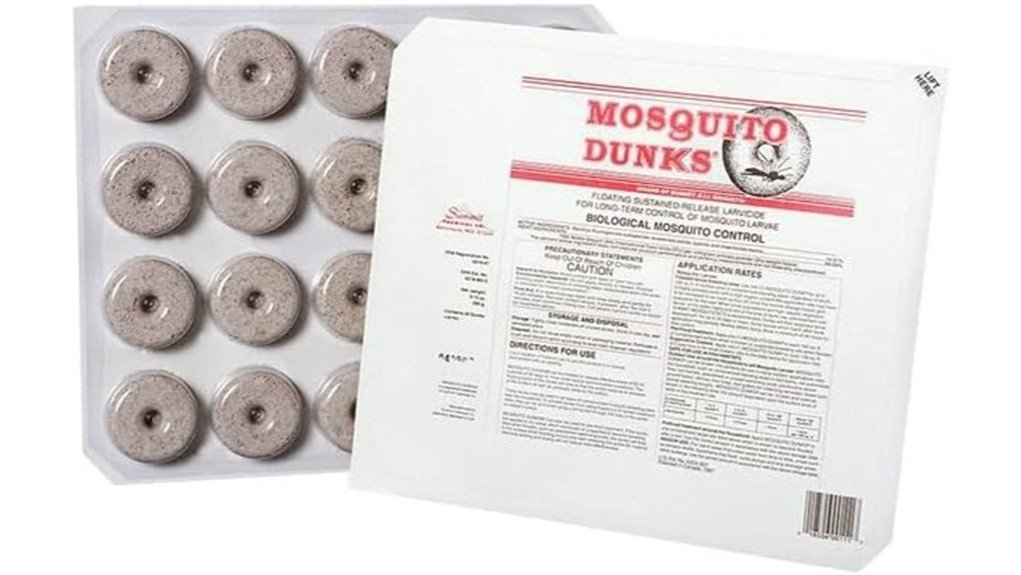
You’ll get twenty Summit Mosquito Dunk tablets containing Bacillus thuringiensis israelensis spores and larvicidal proteins that passively dissolve to treat standing water. You’ll place one dunk per site (up to ~100 sq ft) for roughly 30 days’ control, monitor high turnover or organic‑heavy sites more often, and use gloves while following EPA label directions to protect non‑targets. Track deployment and lot numbers for compliance; continue for specifics on placement, limits, and buying strategy.
Some Key Takeaways
- Contains 20 BTI dunks (strain BMP 144) that release larvicidal proteins targeting mosquito larvae in water.
- One dunk treats up to 100 sq ft of water surface and provides up to 30 days of larvicidal activity.
- Best efficacy in static water and moderate temperatures; heavy organic load or high turnover reduces residual life.
- Handle with gloves, verify EPA registration, and avoid exposing non-target organisms, pets, and beneficial insects.
- Cost-effective for multiple small sites when inventorying water points and scheduling monthly replacements.
What This 20‑Pack of Summit Mosquito Dunk Tablets Actually Contains and How It Works
Although the package looks simple, this 20‑pack contains twenty individual tablet “dunks” each formulated with Bacillus thuringiensis subspecies israelensis (strain BMP 144) in solid/spore form combined with insecticidal proteins; you drop a single dunk into a water source and it releases BTI toxins that target and kill mosquito larvae without harming birds, fish, pets, or humans. You’ll find the pack contents listed plainly: 20 tablets, unit weight 12 ounces, Summit Chemical branding. The application mechanism is passive dissolution: spores and toxins disperse into the water, providing up to 30 days’ larvicidal coverage per dunk across defined surface area. These products are popular among homeowners who care for their lawn and landscape and may also be used alongside pet urine pH neutralizers to maintain a healthy yard.
Where and How to Use Each Dunk for Fast Mosquito‑Larvae Control
When you need rapid larval control, deploy one Summit Mosquito Dunk per designated water site so the tablet can dissolve and release BTI evenly across the surface; each dunk treats up to 100 sq ft and remains effective for up to 30 days. You’ll place dunks in birdbaths, rain barrels, neglected puddles, garden containers, and catch basins where larvae develop. For flowing or large volumes, segment treatment areas and monitor BTI presence weekly. In storm drains, secure dunks in mesh to prevent washout. Track deployment locations and replacement dates so your community maintains continuous, measurable larval suppression. Consider integrating your dunks into a broader rainwater collection strategy to protect stored water while managing mosquito populations.
Safety, EPA Compliance, and Non‑Target Species Considerations
After you’ve placed dunks and set a schedule for replacements, pay close attention to safety labels, EPA registration details, and non‑target organism guidance to guarantee compliant and ecologically responsible use. You should verify the EPA registration number on packaging, follow label directions, and maintain records for environmental monitoring. Use gloves when handling to minimize human exposure and avoid ingesting or inhaling dust. Place dunks where non‑target aquatic organisms, pets, and beneficial insects won’t contact them directly. Engage with local stewardship groups to share best practices and incident reports so your community stays informed and compliant. Also consider using personal protective equipment when mixing or handling lawn chemicals at home to further reduce exposure risks.
Performance Expectations: Coverage, Duration, and Real‑World Results
Assess performance by comparing labeled coverage and duration to observed field results: each Summit Mosquito Dunk tablet is specified to protect approximately 100 sq ft of surface area for up to 30 days, so you should place and replace dunks on that schedule while monitoring larval presence and water turnover rates. In practice, expect full efficacy when water is static and temperatures fall within the BTI activity range; high turnover or heavy organic load reduces residual life. Track seasonal timing to align applications with peak breeding. Record maintenance frequency, site-specific observations, and replacement dates to guarantee consistent community protection and reliable, measurable outcomes. Homeowners who maintain their lawn and landscape should incorporate these practices into their overall crabgrass barrier and pest-management routines.
Buying Tips: When the 20‑Count Makes Sense and How to Get the Best Value
The field-based guidelines on coverage and replacement frequency inform whether a 20‑count pack fits your needs: if you manage multiple small containers (birdbaths, gutters, rain barrels) or a single site with several discrete water points, a 20‑pack lets you maintain a 30‑day replacement cycle without frequent reordering. You should inventory water points, calculate dunks needed (one per 100 sq ft per month), and match to usage. For best value, buy during off-season sales, consolidate orders for bulk storage, and coordinate seasonal planning with neighbors or facility managers to share packs. Track lot numbers and EPA compliance for accountability. Also consider integrating effective grub control practices into your broader lawn and landscape maintenance plan to reduce pest pressures that can indirectly affect mosquito habitats.
Some Questions Answered
Can These Dunks Be Used in Drinking-Water Storage Containers?
No — you shouldn’t use these dunks in drinking-water storage containers. They contain BTI designed to target mosquito larvae; while non-toxic to humans at labeled use, using them in potable water raises contamination risks and regulatory concerns. You should choose approved water-safe treatments or alternative larvicides explicitly labeled for potable systems. If unsure, consult local public health guidance or supplier technical support so your household can safely and inclusively manage mosquito breeding.
Do the Tablets Leave Any Visible Residue or Odor in Water?
No — you won’t see a visible residue or detect a noticeable odor when the tablets are used as directed. The BTI formulation disperses biologically active spores and proteins without leaving particulate deposits or producing a detectable odor at typical treatment concentrations. You can expect clear water appearance and no measurable smell; if you notice cloudiness, particles, or a strong scent, stop use and contact manufacturer support for troubleshooting and safety guidance.
How Should I Store Unused Dunks Long-Term?
Store unused dunks in cool, dry conditions using airtight containers to preserve potency. Seal original packaging or place tablets in labeled, moisture-proof jars or resealable bags; keep away from heat, sunlight, and chemicals. Rotate stock using first-in, first-out and note purchase dates. These storage tips maintain EPA-spec efficacy and let you confidently share supplies with group members, knowing everyone’s products stay effective and safe over long-term storage.
Are These Safe to Use Around Edible Plants or Vegetable Gardens?
Yes — you can use them near edible plants and in vegetable gardens because BTI targets mosquito larvae, not plants, pollinators, or mammals. You’ll protect soil health by avoiding soil incorporation; place dunks in standing water only. Combine with companion planting to reduce adult mosquito habitat and reinforce integrated control. You’ll maintain safety by following label directions, keeping contact off foliage and irrigation inlets, and storing unused dunks per manufacturer guidance.
Can Dunks Be Broken or Crushed to Treat Small Containers?
Yes — you can break dunks for small containers, but avoid crushing into fine powder; crushing concerns center on uneven dosing and dust dispersion. You’ll preserve container compatibility by splitting pieces to approximate recommended contact time and surface coverage, keeping fragments submerged and replacing them monthly. Handle gently, wear gloves if dust forms, and store remaining dunks sealed. This keeps treatment effective while maintaining safety and community-minded stewardship.