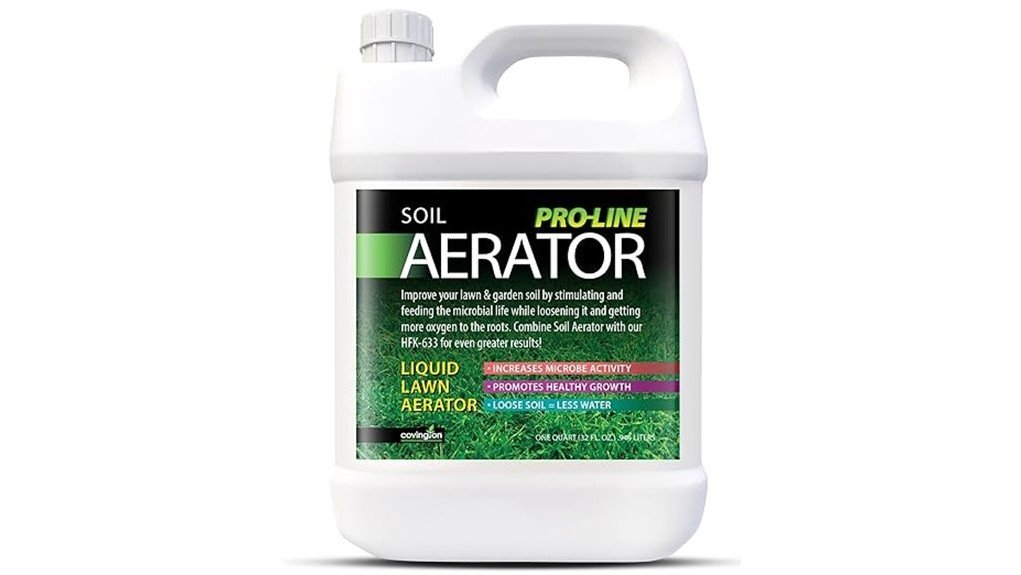
You’ll get a 32‑oz concentrate that you dilute 7:1 to treat about 3,200–5,300 sq ft; it’s aimed at homeowners and grounds crews who can’t use mechanical aerators. Humic and fulvic acids loosen clay, boost microbes, and create microchannels to improve water and root penetration without plugs or equipment. Expect visible drainage improvement in days to weeks, fuller turf and root gains over a season, and repeat every 8–12 weeks for upkeep—details follow if you want more.
Some Key Takeaways
- Professional 32-oz concentrate uses humic and fulvic acids to loosen clay, improve permeability, and stimulate soil microbes.
- Dilute 7:1; one 32-oz bottle treats roughly 3,200–5,300 sq ft depending on application rate.
- Equipment-free application via pump sprayer or hose-end makes it ideal for tight spaces and high-traffic areas.
- Users can expect reduced puddling within days to weeks and root/turf color improvement over a month.
- Best for maintenance and moderate compaction; combine with mechanical aeration for severe compaction.
What This Product Is and Who Should Use Covington Liquid Lawn Aerator PRO-LINE
Think of Covington Liquid Lawn Aerator PRO-LINE as a liquid soil conditioner that loosens compacted and clay-heavy turf without spikes or plugs. You’ll find it’s a 32-oz professional-grade concentrate from Covington Naturals, formulated with humic and fulvic acids to improve soil structure and moisture retention. Use it if you manage lawns, tired garden beds, high-traffic areas or sports fields where mechanical aeration’s impractical. Home gardeners will value the equipment-free application and coverage per quart. You’ll apply a measured mix for deep conditioning, reducing compaction and encouraging stronger roots so your community of gardeners and groundskeepers can share healthier turf. It’s ideal for homeowners and groundskeepers looking to revitalize their lawn without heavy machinery.
How Covington Liquid Lawn Aerator PRO-LINE Works on Clay and Compacted Soil
When you apply Covington Liquid Lawn Aerator PRO-LINE to clay or compacted soil, its concentrated humic and fulvic acids work to loosen dense soil aggregates and stimulate microbial activity that breaks down tight clay particles. You’ll notice improved soil biology as beneficial microbes consume organic compounds, creating microchannels and converting heavy clods into friable material. That biological action, combined with enhanced oxygenation, supports gradual pore restoration, allowing water and roots to penetrate previously impermeable layers. You’ll feel confident recommending it to neighbors or teammates because it complements natural processes, reduces reliance on mechanical aeration, and helps rebuild resilient, better-draining turf and garden soil. Humic acid products like this are prized by homeowners for improving soil structure and plant health through enhanced soil biology.
How to Mix and Apply the 32 Oz Concentrate (Coverage, Ratios, Timing)
Start by diluting the 32‑oz concentrate at the recommended 7:1 ratio (seven parts water to one part product) so you get a ready‑to‑apply solution that treats between about 3,200 and 5,300 sq ft per unit depending on application rate. For mixing instructions, measure accurately into a pump sprayer or hose‑end applicator, shake gently, and top with water. Apply evenly across the lawn when soil is moist but not saturated—early morning or late afternoon is best. For application timing, avoid rain for 24 hours and treat during active growing seasons for best integration into soil structure. Enhance your lawn care routine by pairing liquid aeration with complementary soil and landscape products from a specialized liquid soil aerators supplier.
Realistic Performance: Expected Results, Timelines, and When to Reapply
After you’ve mixed and applied the concentrate as directed, expect to see initial improvements in soil permeability and water behavior within days to a couple of weeks; the humic and fulvic acids act quickly to loosen clay and boost microbial activity, so water will begin infiltrating more evenly and puddling should decrease. Over the next month roots will respond and turf color can improve, while fuller structural change may take a season of regular applications. For long term maintenance, plan repeat treatments every 8–12 weeks during active growth, and adjust seasonal timing—spring and fall give the best response for most lawns. These effects are especially helpful for homeowners maintaining lawn and landscape who use soil structure products to improve permeability and root growth.
Comparing Covington Liquid Lawn Aerator PRO-LINE to Mechanical Aeration and Alternatives
Although mechanical aeration physically removes cores or slices to relieve compaction, the Covington Liquid Lawn Aerator PRO-LINE offers a noninvasive alternative that loosens clay and enhances microbial activity without equipment or soil disruption. You’ll weigh pros and cons: mechanical aeration gives immediate pore creation and suits severe soil compaction, while liquid aeration fits regular maintenance and tighter spaces. Use the liquid to complement mechanical work or follow maintenance schedules for prevention. You’ll appreciate easier application, coverage efficiency, and no plugs to collect. For deep, extreme compaction, combine methods; for ongoing care, the PRO-LINE is practical and community-friendly. The product is designed for homeowners maintaining lawns and landscapes and can simplify routine care for many properties while reducing the need for heavy equipment in residential lawn care.
Some Questions Answered
Is This Product Safe for Pets and Children After Application?
Yes — you can generally let pets and children back onto treated areas once the product has fully dried and been watered in per label directions. You’ll reduce pet safety and child exposure risks by following mixing, application, and re-entry instructions, rinsing spills, and storing product securely. If you’re unsure, consult the product label or contact Covington Naturals for specific guidance to guarantee safe use and community peace of mind.
Can I Mix It With Fertilizers or Herbicides?
You can tank mix it with some fertilizers or herbicides, but you’ll check application compatibility first. Follow label directions and perform a small jar test to confirm no reaction. Avoid mixing with strong acids, undiluted concentrates, or incompatible herbicide chemistries. If unsure, contact the manufacturer or a local extension agent for guidance. Doing this helps you maintain effective tank mixing while protecting your lawn, equipment, and community.
Does It Stain Driveways, Sidewalks, or Clothing?
It’s unlikely to cause noticeable staining, but you should avoid direct spills to prevent any color transfer to driveways, sidewalks, or clothing. You’ll find the formula generally compatible with common surfaces, yet porous concrete or light fabrics might show temporary marks. Wear protective clothing and clean accidental splashes promptly with water. If surface compatibility matters, test a small hidden area first to confirm no lasting discoloration.
What Is the Product’s Shelf Life and Storage Temperature?
You should expect a typical expiration date of about 2 years from manufacture; check the label for the exact expiration date and batch info. Store the product at a cool, stable storage temperature between 40–75°F (4–24°C), out of direct sunlight and freezing. Keep the container sealed and upright to maintain potency. If you’re unsure, contact the manufacturer with your lot number for confirmation and guidance.
Are There Any Plants or Grass Types to Avoid Using It On?
You can generally use it on most turf, but avoid applying to newly seeded lawns until seedlings are well established; wait until grass has several true leaves. Be cautious with warm season grasses during active stress (drought or extreme heat); don’t treat when plants are already weakened. If you’re unsure about a specific species or sensitive ornamental, test a small area first so your lawn-care community feels confident and supported.