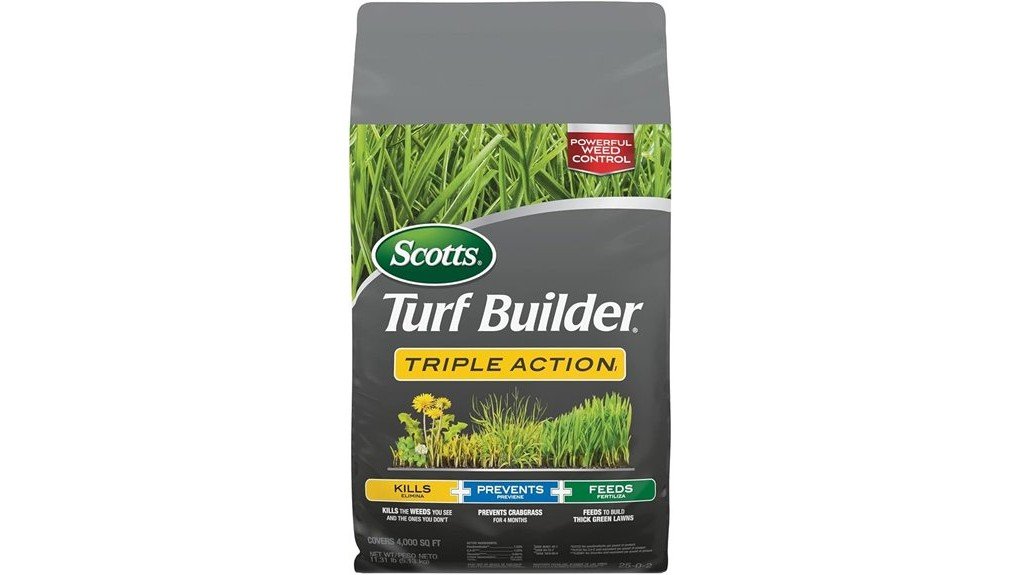
You’ll get preemergent crabgrass suppression, post-emergent broadleaf knockdown, and a fertilizer boost in one granular application that treats up to 4,000 sq. ft. per 11.31 lb bag. Pendimethalin curbs grassy weed germination for months, dicamba controls common broadleafs, and nutrients improve turf density to resist reinfestation. Apply early spring with a calibrated spreader, water lightly after 24 hours, and follow label precautions. Continue for full application, timing, safety, and turf-specific guidance.
Some Key Takeaways
- Provides preemergent crabgrass prevention, post-emergent broadleaf weed control, and fertilizer boost in one granular product.
- One 11.31 lb bag treats up to 4,000 sq. ft. at about 2.8 lb per 1,000 sq. ft. when applied per label.
- Effective on labeled turf species (e.g., Kentucky bluegrass, bermudagrass, fescues, zoysia) when applied in early spring.
- Pendimethalin suppresses grassy weed germination; dicamba controls common broadleaf weeds like dandelion and clover.
- Follow label for timing, spreader calibration, irrigation, PPE, and re-entry restrictions to minimize turf injury and environmental risk.
Verdict Upfront: Is Scotts Turf Builder Triple Action Worth Buying?
Cutting to the chase: Scotts Turf Builder Triple Action delivers a pragmatic, threefold approach—prevention of listed grassy weeds (including crabgrass for up to four months), post-emergent control of many common broadleaf weeds, and a fertilizer boost to thicken turf—which makes it a solid choice if your lawn matches the listed grass types and you apply it correctly in early spring. You’ll get measurable coverage (4,000 sq. ft., 11.31 lb) and known actives (pendimethalin, dicamba). Use fits routine preventive programs, but weigh potential long term residues and environmental impact; follow label rates and re-entry restrictions to protect neighbors and pets. It’s also well suited for homeowners looking for concentrated summer fungicide options to integrate into their lawn and landscape care routines.
How Well It Works : Weed Control, Crabgrass Prevention, and Lawn Feeding
When applied as directed, Scotts Turf Builder Triple Action combines pendimethalin’s preemergent control with dicamba’s postemergent activity and a fertilizer charge to deliver measurable reductions in common broadleaf weeds while preventing listed grassy weeds for up to four months. You’ll observe reliable seasonal effectiveness: preemergent pendimethalin suppresses crabgrass germination across spring into summer, while dicamba targets actively growing broadleafs like dandelion and clover. The fertilizer component promotes density, reducing future weed ingress. Expect a single timely treatment to cover most needs; adjust application frequency based on infestation pressure and seasonal growth patterns to maintain community-standard turf health. It is widely available from retailers that specialize in granular lawn fertilizers and homeowner lawn care products, making it easy to purchase for routine lawn maintenance.
When and How to Apply for Best Results (Timing, Spreader, Watering, Safety)
Early in the spring, apply Scotts Turf Builder Triple Action as part of your routine lawn prep: use a calibrated Scotts broadcast or drop spreader for uniform granule distribution, target actively growing broadleaf weeds (like dandelion) and treat before crabgrass germination, and follow label rates to cover 4,000 sq. ft. with an 11.31 lb bag. Calibrate the spreader, walk at steady pace, and prioritize even pass overlap. Apply to dew-wet turf to guarantee granular adherence to leaves; after 24 hours irrigate lightly to move actives into the soil. Restrict access until dust settles, and follow label PPE and re-entry intervals. For best results, keep essential spreader calibration tools on hand to ensure accurate application.
Which Lawns It’s Safe For and Which Weeds It Targets
After preparing and applying Triple Action as recommended, check that your turf species is listed on the label—Scotts specifies compatibility with Bahiagrass, Centipedegrass, Kentucky bluegrass, Perennial ryegrass, Bermudagrass, Tall and Fine fescues, and Zoysiagrass—because pendimethalin and dicamba rates and phytotoxic risk vary by species. You’ll see warm season and cool season grasses among compatible species; follow label timing for each. Triple Action targets targeted weeds: listed broadleaf weeds (dandelion, clover, chickweed, plantain, etc.) and prevents listed grassy weeds including crabgrass, foxtails, barnyardgrass and annual bluegrass. Match species, timing, and label rates to minimize turf injury. Our product selection focuses on supplying superior grass fertilizers for homeowners maintaining their lawn and landscape.
Value and Buying Tips : Coverage, Cost per 1,000 Sq Ft, Alternatives to Consider
One 11.31 lb bag of Scotts Turf Builder Triple Action treats up to 4,000 sq ft, so you’ll cover that area at roughly 2.8 lb per 1,000 sq ft. Calculate cost per 1,000 sq ft by dividing bag price by four; that yields a reproducible metric for price comparison across products. Evaluate bulk buying if you manage larger turf areas—unit costs drop and stocking aligns with seasonal sales. For alternative brands, compare active ingredients and labeled weeds; pendimethalin/dicamba profiles differ from others. Use spreader calibration, follow label application rates, and choose suppliers that support your local lawn-care community. Homeowners should prioritize products designed for crabgrass barriers when protecting lawn and landscape.
Some Questions Answered
Is This Product Pet-Safe After Granules Settle?
No — you shouldn’t assume it’s fully safe after granules settle. The product contains pendimethalin and dicamba; pet exposure risk remains if granule ingestion or grooming transfers residues. You should keep pets off treated areas until dust has settled and follow label wait times; water in after 24 hours to reduce surface residue. If ingestion or symptoms occur, contact your veterinarian or a poison control center promptly for guidance.
Can I Overseed My Lawn After Applying It?
No — you shouldn’t overseed immediately after applying; wait. Seeding timing matters: this product prevents grassy weed germination for up to four months, so overseeding cool-season or warm-season grasses right away will fail. For success, plan soil preparation and seeding after the herbicide residual declines—typically 2–4 months depending on conditions and seed type. Test a small patch first, follow label replant intervals, and collaborate with neighbors for shared lawn standards.
Will It Stain Driveways, Patios, or Clothing?
No, it’s unlikely to stain driveways, patios, or clothing if you follow directions. You’ll minimize staining potential by applying granules carefully, avoiding hard surfaces, and sweeping up application residue. If granules land on pavement or fabric, remove them promptly and rinse with water; wash clothing separately. These steps reduce chemical contact and visible residue, keeping shared outdoor spaces and your gear clean while you treat your lawn responsibly.
How Long Before Rainfall Is Application Effective?
Apply at least 24 hours before rainfall for ideal timing; that lets granules settle and avoids wash-off. You’ll rely on water activation: after initial 24-hour set, a light irrigation (or rain) moves actives into the soil to prevent grassy weeds. If heavy rain is forecast within 24 hours, delay application. Follow spreader and safety instructions so you and your neighbors can confidently treat the lawn together.
Is It Safe to Use Near Vegetable Gardens or Flower Beds?
No, you shouldn’t apply it directly adjacent to vegetable gardens or flower beds. The active ingredients can cause soil contamination and may lead to root uptake by nearby non-target plants. Apply with buffer zones, avoid drift, and use barriers or timing to minimize exposure. Follow label distances and re-entry intervals; doing so protects your edible and ornamental plants and keeps your gardening community safe and inclusive.