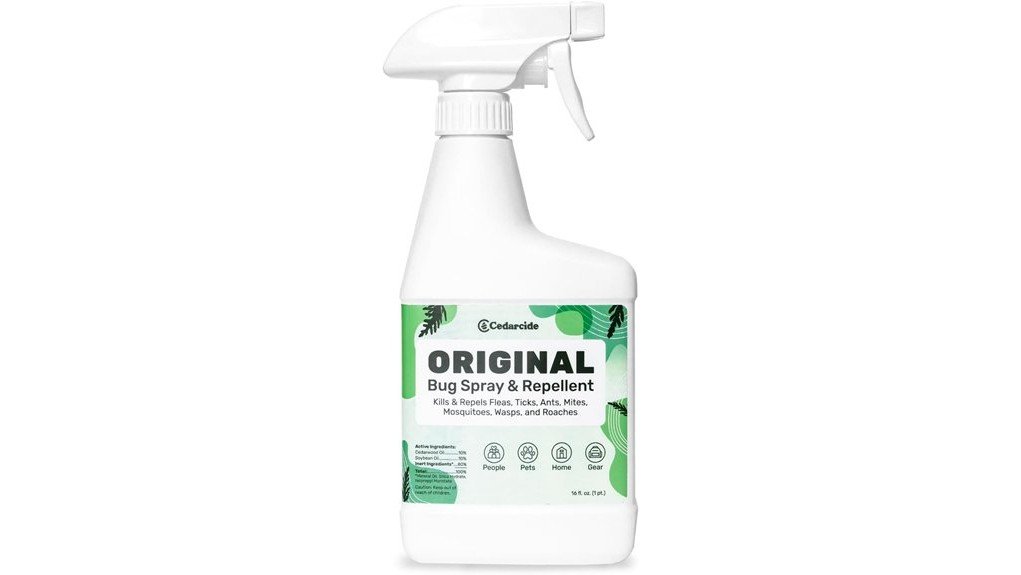
You’ll find Cedarcide Original uses refined cedarwood oil (high in cedrol and terpenoids) that interacts with insect chemoreceptors and neural pathways to repel and knock down mosquitoes, ticks, fleas, ants, chiggers, and mites on contact. Performance is rapid in lab assays and user reports, with predictable short‑term barriers and low environmental persistence. It’s suitable for homes, pets, and perimeters when used as directed, and you can learn more about efficacy, safety, and application specifics below.
Some Key Takeaways
- Cedarcide Original uses refined cedarwood oil (cedrol-rich) as the active ingredient, providing natural contact repellency and insecticidal effects.
- Users and lab assays report rapid knockdown and deterrence against mosquitoes, ticks, fleas, ants, chiggers, and mites.
- Effectiveness is immediate but short-lived; consistent reapplication is recommended during peak pest activity.
- Lower toxicity and fast environmental breakdown make it safer than many synthetic neurotoxic insecticides when used as directed.
- Practical for homes, pets, and perimeter treatments; follow label directions and use protective gear with concentrates.
What Cedarcide Original Is and How Its Natural Cedar Oil Works
What makes Cedarcide Original effective is its concentrated, natural cedar oil formulation: refined cedarwood oil functions as the active ingredient that repels and kills arthropods by disrupting their respiratory and nervous systems on contact. You’ll observe a defined mode of action: aromatic compounds—primarily cedrol and allied terpenoids—interact with insect chemoreceptors and neural pathways, producing rapid repellency and lethal effects. The product references historical use of cedar in dwellings and textiles as empirical precedent, translating tradition into measurable outcomes. You’ll appreciate standardized extraction, consistent concentrations, and transparent labeling that let you integrate Cedarcide confidently with your household pest regimen. It provides an option for homeowners seeking non-toxic pest control that aligns with eco-friendly lawn and landscape maintenance.
Which Pests Cedarcide Actually Repels and Kills (Mosquitoes, Ticks, Fleas, Ants, Chiggers, Mites)
Cedarcide Original targets a broad spectrum of common arthropod pests—mosquitoes, ticks, fleas, ants, chiggers, and mites—by delivering concentrated cedar oil that both repels and kills on contact. You’ll observe behavioral disruption: mosquitoes avoid treated zones, ticks detach, fleas and mites lose grip, ants alter foraging, chiggers withdraw. The formulation leverages known insect behavior pathways rather than broad neurotoxicity, so you get targeted efficacy. Use it indoors, on pets, and around entry points to reduce infestations. Seasonal effectiveness aligns with pest life cycles; regular application during peak months maintains a protective barrier that supports household and community wellbeing. It also fits well with eco-friendly pest control approaches favored by homeowners seeking organic solutions.
Real-World Performance: Lab Results, User Experience, and Speed of Action
Frequently, lab assays and user reports converge to show that concentrated cedar oil produces rapid knockdown and repellency: controlled laboratory tests record significant mortality and deterrence within minutes of exposure for mosquitoes, ticks, fleas, and mites, while field users consistently report noticeable reductions in biting and visible pest activity shortly after application. You’ll see lab efficacy data showing high immediate contact mortality and short-term repellency windows. User testimonials corroborate swift perceived relief in homes and on pets. You can expect prompt speed of action for localized treatments; consistent reapplication maintains community-level reductions and supports shared confidence among users. Homeowners who maintain their lawn and landscape can also integrate beneficial nematodes as a complementary biological approach to pest management.
Safety, Environmental Impact, and Suitability for People, Pets, and Indoor Use
While based on a natural cedar oil active ingredient, the product is formulated and labeled so you can apply it around people and pets with minimal risk when you follow directions; its toxicity profile is low compared with synthetic neurotoxic insecticides and it primarily acts through contact and olfactory deterrence rather than systemic absorption. You’ll appreciate documented low persistence and rapid breakdown, which limits chemical residues on surfaces. Use conservatively indoors, maintain adequate indoor ventilation during and after application, and avoid direct application to mucous membranes. The eco-profile is favorable; it reduces ecological load versus broad‑spectrum synthetics, supporting shared household safety. It also complements other eco-friendly fungicide approaches recommended for lawn and garden care.
Who Should Buy It, How to Use It, and Buying Tips (Sizes, Application, Guarantee)
Given the low-toxicity profile and rapid environmental breakdown described above, you can target this product where contact-based control and routine deterrence are desired—homes with children and pets, cabins, garages, and entry points where pests congregate. You should buy if you want a family-safe, fast-contact option that fits into communal living. Choose budget sizes based on treated area: small bottles for personal use, gallon concentrates for perimeter treatments. Apply to entry points, pet bedding (as directed), and clothing; reapply after heavy activity or rain. Note seasonal timing: increase applications during peak vector months. The 100% satisfaction guarantee reduces purchase risk. For safe mixing and application at home, always use appropriate personal protection such as gloves and eye protection when handling concentrates and during spray preparation, especially if you are doing lawn chemical mixing.
Some Questions Answered
Can Cedarcide Be Used on Edible Plants or Vegetable Gardens?
Yes — you can use it on edible plants with caution. For edible plant safety, apply only as directed, avoiding harvest surfaces and rinsing produce before eating. Use targeted garden application methods: spot-spray foliage, treat perimeter barriers, and avoid bloomed flowers to protect pollinators. You’ll follow label instructions, apply in cooler hours, and reapply at recommended intervals so your shared garden stays effective, safe, and welcoming.
How Long Does the Cedar Scent Typically Linger Indoors?
You’ll notice the cedar scent typically lingers indoors for 6–12 hours under normal conditions. Fragrance longevity depends on surface type, application amount, and indoor ventilation; better airflow shortens persistence. You’ll observe longer residual aroma on fabrics and carpets versus hard surfaces. In shared spaces, adjust dosing and ventilation to balance efficacy and comfort so everyone feels included; reapply as needed for ongoing repellent performance while maintaining air circulation.
Is Cedarcide Safe to Spray Near Bees and Pollinators?
Yes — you can use it cautiously near bees; the product’s cedar oil formulation minimizes bee safety and pollinator impact when applied away from active foraging areas. You should spray at ground level, avoid blooms, and treat in early morning or late evening when pollinators are less active. You’ll protect your garden community by following directions, limiting drift, and using targeted applications to reduce unintended exposure for bees and other pollinators.
Does Cedarcide Stain Fabrics or Damage Furniture Finishes?
No, it generally won’t stain fabrics or damage furniture finishes when you use it as directed. You’ll find fabric safety is high due to the natural cedar oil formulation; nonetheless, you should test an inconspicuous spot first. Observe finish effects on varnished, painted, or antique surfaces before broader application. You’ll appreciate the practical, community-minded approach: safe, eco-conscious use with simple precautions to protect textiles and finishes.
Are There Any Known Drug or Medical Product Interactions?
No known drug interactions or medical contraindications exist with this cedar-oil product when used as directed. You shouldn’t expect systemic interactions with pharmaceuticals, but you should avoid use on broken skin, near eyes, or on individuals with confirmed cedar allergies. If you’re pregnant, nursing, or managing severe respiratory conditions, consult your clinician before use. Report any adverse reactions to your healthcare team to maintain safety within your community.