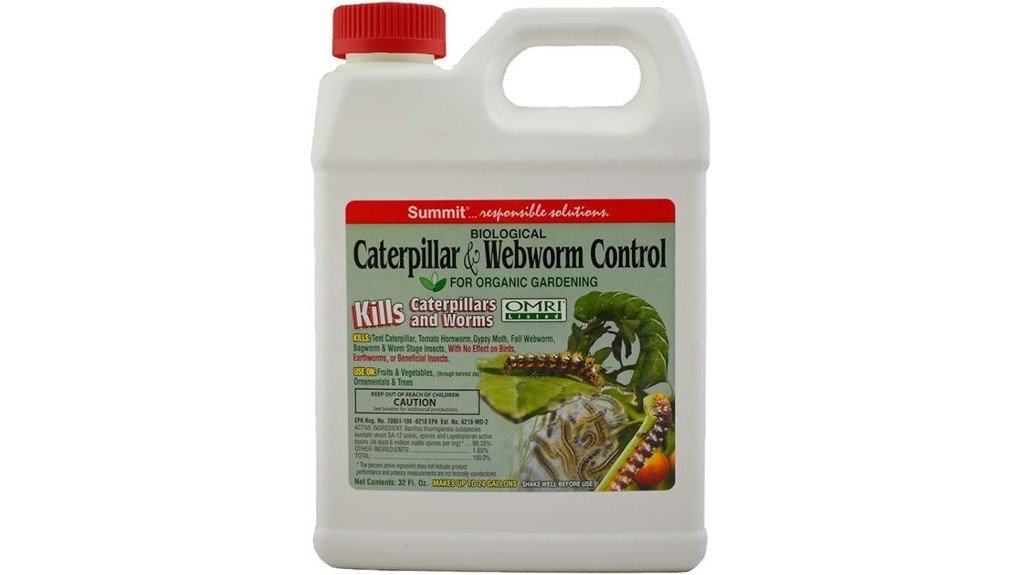
You’ll get fast, larva-specific control of defoliating caterpillars and webworms when you apply Summit BTK Hose-End to actively feeding foliage. The Btk spores activate in the alkaline caterpillar gut and release endotoxins that create gut lesions, stop feeding, and kill early-instar larvae within 1–5 days. Apply at label rates, target young instars, and expect variability from canopy density and rain. It’s OMRI-listed and safe on edible crops when used as directed, and more details follow.
Some Key Takeaways
- Summit Hose-End uses Bacillus thuringiensis subsp. kurstaki (Btk) targeting lepidopteran larvae like caterpillars and webworms.
- Best applied to actively feeding early-instar larvae for mortality and feeding cessation within 1–5 days.
- Product requires ingestion; ineffective against eggs, pupae, or non-feeding stages.
- Calibrate hose-end sprayer, maintain uniform canopy coverage, and reapply per label, especially after rain.
- OMRI-listed, safe for edible crops to harvest day when used per label, and compatible with organic/IPM programs.
How Summit BTK Hose-End Works and What Pests It Controls
Summit BTK Hose-End works when caterpillar larvae ingest spores of Bacillus thuringiensis subsp. kurstaki (Btk); in the alkaline gut the spores activate and release endotoxins that create gut lesions, halt feeding, and kill larvae within 1–5 days. You’ll apply a biological agent with precise larval specificity, affecting only lepidopteran larvae and sparing non-targets. The formulation exploits gut activation pathways unique to caterpillars, so timing against early instars improves efficacy. You’ll value low environmental persistence and compatibility with organic systems, but you should integrate resistance management practices—rotate tactics and monitor populations—to maintain long-term control and community stewardship. For homeowners managing turf and landscape, consider integrated practices that also address pythium disease risks in lawns to keep plants healthier and less susceptible to secondary pest problems.
Quick Setup and Step-by-Step Application for Best Results
Before you attach the hose-end, confirm the treatment area, dilution rate, and target timing so you apply the concentrate effectively; read the label for exact mixing ratios and safety precautions, inspect the nozzle and O-rings for integrity, and flush the hose to remove debris. Next, set hose end calibration per label: select flow setting and verify output volume over 30 seconds to confirm dilution. Apply during active larval feeding periods; adjust application timing to early morning or evening to reduce photodegradation. Maintain uniform spray overlap, treat entire canopy, and reapply per label intervals. Rinse device and store upright when finished. Choose a sprayer designed for homeowner use to ensure proper coverage and easy handling.
Performance: Effectiveness on Common Caterpillars and Timing
When applied to actively feeding larvae, this Btk-based hose-end concentrate delivers reliable control of common lepidopteran pests because its endotoxin must be ingested to disrupt the alkaline gut, causing feeding cessation and mortality within 1–5 days; you should consequently target early-instar caterpillars for maximum efficacy and expect reduced control on eggs, pupae, or adults. You’ll time applications to larval peaks, monitoring for neonates and reapplying at label intervals to maintain coverage. Expect field variability from canopy density, rain wash-off, and pest pressure. Rotate tactics to reduce larval resistance and integrate scouting so your community of growers shares successful application timing. Use crabgrass barriers to protect surrounding turf and reduce overall maintenance needs while managing caterpillar outbreaks with lawn care products.
Safety, Organic Approval, and Use on Edible Plants
Because the active ingredient is Bacillus thuringiensis subsp. kurstaki (Btk), you can use this hose-end concentrate on edible plants with minimal non-target impact, including fruits and vegetables up to the day of harvest. You’ll appreciate that Btk targets lepidopteran larvae via gut-specific endotoxins, sparing pollinators and vertebrates. The product is OMRI listed and meets common organic certification standards, supporting integrated organic programs. Follow label rates, reapply for new larval cohorts, and avoid drift to sensitive ornamentals. Documentation and manufacturer support reinforce consumer safety claims; you’ll join peers who prioritize verified, low-risk tools for food-producing landscapes. It’s a convenient option for homeowners seeking quick-green liquid solutions for lawn and landscape care.
Who Should Buy It and Alternatives to Consider
If you grow fruits, vegetables, or ornamentals and regularly face defoliating caterpillars, this Summit Btk hose-end concentrate is a practical, low-toxicity option that targets early-instar lepidopteran larvae while preserving pollinators and vertebrates. You should buy it if you want an OMRI-listed, ingestion-dependent tool that’s safe for edible crops and integrates into IPM. It suits beginner gardeners needing straightforward coverage and small-scale producers valuing organic compliance. Larger or persistent outbreaks may require rotational tactics; commercial growers should consider supplementary measures such as mechanical removal, pheromone disruption, Bt formulations with different strains, or selective spinosad products for broader control. This product aligns with city-approved approaches for homeowner lawn and landscape pest control and complements other effective pest control strategies.
Some Questions Answered
Can This Concentrate Be Mixed With Other Garden Products?
Yes — you can mix this concentrate cautiously, but check Mixing compatibility and avoid adverse Chemical interactions. Btk formulations are generally compatible with many water-based organic products, but you shouldn’t combine with strong oxidizers, high-pH solutions, or broad-spectrum synthetic insecticides that could inactivate the bacterial endotoxin. Test any tank mix on a small area first, follow label directions, and consult manufacturer guidance so you’ll belong to a safe, effective treatment practice.
How Long Does One Bottle Treat My Yard Area?
One 32 fl oz bottle will treat roughly 2,000–4,000 sq ft depending on coverage area and application rates you choose. You’ll follow label application rates to mix the concentrate with water at the hose-end; higher dilution treats more area but delivers lower Btk per sq ft. Apply to target foliage until wet. Reapply per label intervals or after heavy rain to maintain control and protect early-instar larvae.
Does It Have a Noticeable Odor During Application?
You won’t detect a strong application smell; the product has a minimal noticeable scent during application. You’ll notice a faint, earthy odor when sprayed, typical of biological larvicides, but it dissipates quickly. You’re unlikely to find it intrusive or irritating; it’s formulated for use around edible plants and outdoor spaces. You’ll appreciate that the low odor aligns with organic-friendly handling and community-minded gardening practices.
Is the Hose-End Adapter Compatible With All Hose Threads?
No — it isn’t guaranteed compatible with all hose threads. You should verify male/female hose threading standards (typically 3/4″ GHT in the U.S.) before purchase. Inspect the adapter and perform adapter leakage testing after installation; check for rubber gaskets and secure seals. If threading differs, use a certified reducer or thread adapter. You’ll feel confident joining equipment when you confirm standards and validate a drip-free connection.
What Is the Shelf Life Once Opened?
Once opened, you can expect at least 1–2 years of storage stability if you keep the concentrate sealed, cool, and out of direct sunlight. You should shake before use and store upright to prevent leaks. Follow local regulations for container recycling when empty; rinse according to label directions prior to recycling. This guidance helps you preserve product efficacy and join others committed to safe, sustainable pesticide handling and disposal.