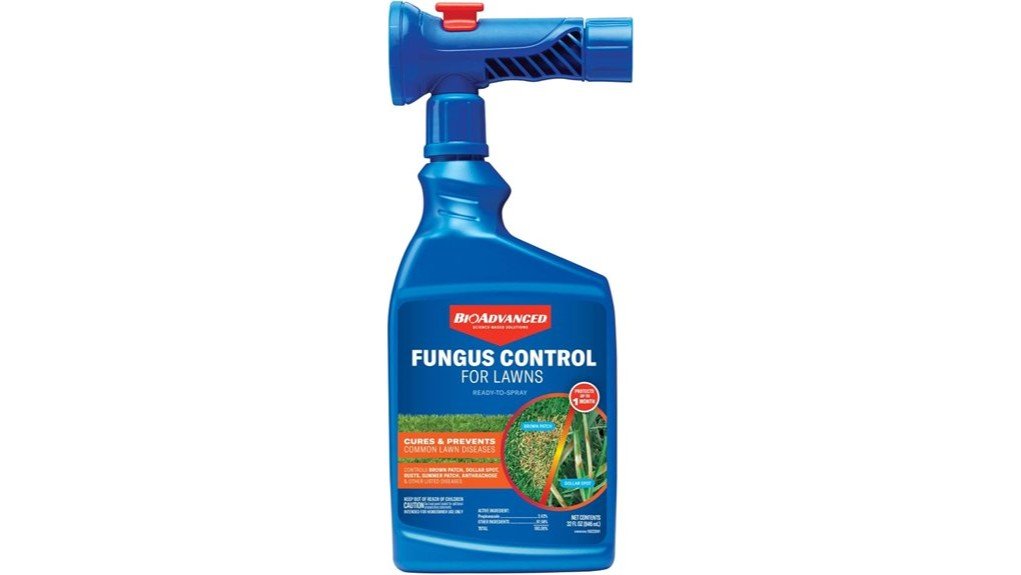
You’ll get a lab-backed propiconazole 2.42% fungicide that gives systemic curative and preventive control of common turf diseases like brown patch, dollar spot, rust, and anthracnose. One 32 fl oz bottle treats about 5,000 sq ft, with symptom reduction in days and up to ~30 days’ protection per application in trials. Apply at first symptoms or every 4–6 weeks, follow label safety and resistance-avoidance guidance, and keep reading for full usage and alternatives.
Some Key Takeaways
- Contains propiconazole 2.42% systemic DMI fungicide for curative and preventive control of common turf diseases.
- Controls brown patch, dollar spot, rust, red thread, summer patch, and anthracnose with symptom reduction in days.
- One 32 fl oz ready-to-spray bottle treats up to about 5,000 sq ft and is rainfast after drying.
- Offers roughly up to 30 days’ protective residual per application when used as directed.
- Best used with label instructions, resistance-avoidance practices, and cultural controls for optimal results.
Quick Verdict: Does BioAdvanced Fungus Control for Lawns Work?
Although outcomes vary with disease pressure and application timing, BioAdvanced Fungus Control for Lawns provides reliable control and prevention for common turf diseases when used as directed. You’ll see reduced lesion spread and restored turf density within weeks; trials report up to 30 days’ protection per application. Data-driven user testimonials corroborate visible declines in Brown Patch, Dollar Spot, and Rust incidence, improving lawn aesthetics and uniformity. You’ll apply the ready-to-spray formula easily for spot or broader treatments. Follow label rates and reapplication intervals to maintain systemic activity and minimize resistance risk, aligning performance with community expectations. Homeowners should choose products tailored to their lawn maintenance needs to ensure effective disease management and proper application.
What’s in the Bottle: Propiconazole 2.42% Specs and Coverage
Inspect the label and you’ll find propiconazole listed at 2.42% as the active ingredient, a systemic demethylation-inhibiting (DMI) fungicide registered under EPA No. 92564-47; this concentration and registration indicate the formulation is designed to be absorbed by turf for curative and preventive control of listed pathogens across up to 5,000 sq ft per 32 fl oz bottle. You’ll get an ingredient breakdown showing propiconazole as the sole active component with inert carriers and surfactants to aid uptake. Application coverage is fixed at 5,000 sq ft per bottle; follow label rates, timing, and safety precautions for effective, compliant use. This product is intended for homeowners maintaining lawns as part of a preventative turf fungicide program.
Real-World Results: Diseases Controlled, Protection Period, and Performance
When you apply BioAdvanced Fungus Control as directed, its propiconazole 2.42% formulation delivers systemic, DMI-mode protection that both cures active infections and prevents new outbreaks of listed turf diseases—including red thread, brown patch, dollar spot, rust, summer patch, and anthracnose—across the labeled 5,000 sq ft per bottle; in practice you’ll observe symptom reduction within days and preventive efficacy lasting up to 30 days per application. Field performance aligns with label claims: rainfast absorption, broad-spectrum control, and measurable turf recovery. Pair regular disease monitoring with appropriate application frequency to maintain season-long resilience; this product integrates into community turf programs seeking reliable, evidence-based results. For homeowners, choosing broad-spectrum products and following essential application tips can help achieve consistent lawn health and disease suppression, especially when integrated with lawn maintenance best practices.
How to Use It Safely and Effectively (Application, Timing, and Troubleshooting)
Having seen how propiconazole 2.42% performs in controlling and preventing common turf diseases, you’ll want to apply BioAdvanced Fungus Control with attention to timing, dose, and safety to maximize results and minimize risk. Read label for application safety: wear gloves, avoid inhalation, and keep children/pets off treated turf until dry. Use the hook‑to‑hose applicator for even coverage; one 32 fl oz bottle treats ~5,000 sq ft. Apply at first symptoms or proactively every 4–6 weeks (up to 30 days protection). Rotate practices to reduce resistant strains: combine cultural controls, avoid overwatering, and reapply only per label directions. For homeowners seeking greener options, consider integrating eco‑friendly fungicides alongside conventional treatments to reduce environmental impact.
Should You Buy It? Pros, Cons, Price Points, and Where to Get It
While no product is a universal solution, BioAdvanced Fungus Control offers a technically robust option if you need targeted, systemic protection against common turf diseases. You’ll get propiconazole 2.42% in a ready-to-spray 32 fl oz hook-to-hose applicator covering ~5,000 sq ft, EPA-registered, rainproof, and effective up to 30 days. Pros: easy application, systemic cure/prevent action, documented spectrum. Cons: chemical exposure considerations, limited residual compared with some professional programs. Price points vary by retailer; check retail availability at big-box stores and online marketplaces. Compare competitive alternatives (other propiconazole or multi-active mixes) before buying. For homeowners maintaining their lawn and landscape, consider integrated cultural practices alongside treatment for best results and targeted leaf spot management.
Some Questions Answered
Is It Safe to Use Around Pets and Children After Application?
Yes — you can use it safely if you follow label instructions: wait until the spray has dried/been absorbed before allowing pets or children back on treated turf. Pet safety depends on exposure timing; propiconazole is systemic and rainproof once absorbed, reducing surface residues. Keep off lawn during application and until dry (per label), store product securely, and follow reentry intervals and any specific precautions to minimize accidental exposure.
Can This Be Applied to Newly Seeded or Sodded Lawns?
You shouldn’t apply it immediately to newly seeded areas; wait until seedlings have established and you’ve done the recommended seeding wait time—typically 4–6 weeks or when root systems tolerate systemic fungicide. For sod establishment, you can usually treat after the sod has rooted (about 2–3 weeks) and shows active growth. Always follow label directions for timing, rates and safety to guarantee effective disease control and community-safe use.
Does It Affect Beneficial Insects Like Bees or Earthworms?
You’re unlikely to see acute bee safety or earthworm impact after soil uptake of propiconazole at labeled rates, since it’s systemic and primarily targets fungi; however, topical residues during spraying can expose foraging bees and surface-active invertebrates. Follow label timing to avoid blooming periods and don’t overspray; for earthworm impact, avoid excessive repeated applications. You belong to a community that protects pollinators—use precautions and integrated pest management.
How Should Unused Product Be Stored and Disposal Instructions?
Store unused product in its original, tightly closed container, in a cool, dry, well-ventilated area away from heat, children and pets; follow label storage instructions and keep upright to prevent leaks. For disposal guidance, don’t pour down drains or on soil; contact your local waste agency or follow label directions for pesticide disposal and container rinsing; you’ll protect your community and comply with regulations by using recommended municipal hazardous-waste programs.
Is This Product Compatible With Other Lawn Care Treatments?
Yes — you can mix it cautiously, but watch chemical interactions and timing considerations. You’ll avoid tank-mixing with unknown products; follow label guidance and test a small area. Don’t combine with alkaline or incompatible herbicides without proven compatibility. You’ll space applications to prevent overlapping systemic uptake and stress: allow recommended intervals between fungicide, fertilizer, and insecticide. If unsure, consult product labels or manufacturer for compatibility data to keep your lawn safe.