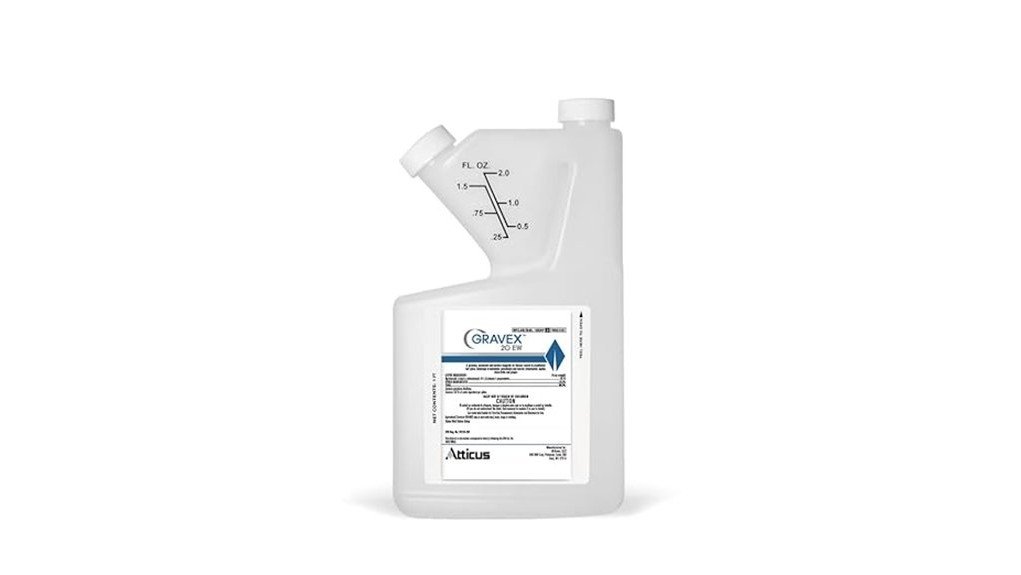
You’ll get a 19.7% myclobutanil emulsifiable concentrate that provides systemic upward translocation and curative plus preventive control of over 38 foliar and turf pathogens, with labeled residual protection up to 28 days. Apply 0.5–1.0 fl oz/1,000 sq ft on turf in 2–4 gal water, adjust for ornamentals, and follow 14–28 day reapplication intervals. Use proper PPE, avoid drift, and rotate modes of action to manage resistance — continue for full label, safety, and comparison details.
Some Key Takeaways
- Atticus Gravex 20 EW is a 19.7% myclobutanil emulsifiable concentrate for preventive and curative control of many foliar and turf diseases.
- Provides systemic upward translocation protecting new growth with residual control up to 28 days when labeled rates are used.
- Effective against over 38 pathogens including brown patch, anthracnose, and powdery mildew in turf and ornamentals.
- Apply 0.5–1.0 fl oz per 1,000 sq ft in 2–4 gallons water for turf, repeating every 14–28 days as label directs.
- Single‑site triazole chemistry has resistance risk; rotate modes of action and follow label safety, drift, and pollinator precautions.
What Atticus Gravex 20 EW Is and How It Works
Although marketed as a ready-to-use concentrate, Atticus Gravex 20 EW is a technical emulsifiable concentrate formulation containing 19.7% myclobutanil, a systemic triazole fungicide that translocates upward in plant tissue to protect new growth. You’ll measure dilution precisely, following label rates for target species and sites. As a systemic fungicide its mode-of-action inhibits sterol biosynthesis, delivering curative and preventive control when absorbed. Application chemistry matters: emulsification, water pH, and spray volume affect uptake and distribution. You’ll appreciate the clear label specifications, EPA registration notes, and packaging metadata that let your team apply product consistently and confidently across approved landscapes. Choose fungicides thoughtfully using broad-spectrum selection criteria to match your lawn and landscape needs.
Performance Recap: Diseases Controlled, Systemic Action, and Residual Protection
When you assess Atticus Gravex 20 EW’s performance, the data show consistent preventive and curative activity against a broad spectrum of foliar and turf pathogens while providing systemic protection for new growth. You’ll see control across a wide fungal spectrum — brown patch, anthracnose, powdery mildew and more — with efficacy documented on over 38 pathogens. Its systemic longevity delivers protection into new tissue, supporting turf resilience after stress. Residual protection lasts up to 28 days per label, informing an evidence-based application interval. Use these metrics to integrate Gravex into your disease management program with confidence. It is formulated as a concentrate designed for homeowners maintaining their lawn and landscape.
How to Use Gravex 20 EW Safely and Effectively (Rates, Timing, and Application Tips)
Having established Gravex 20 EW’s spectrum, systemic movement, and up-to-28-day residual, you can plan applications to maximize control while minimizing inputs and resistance risk. Apply 0.5–1.0 fl oz per 1,000 sq ft (follow label) in 2–4 gallons water for turf; adjust rates for ornamentals and fruit per label charts. Time preventively at disease onset risk and curatively at first symptoms; repeat no more than every 14–28 days. Wear required personal protective equipment and follow environmental precautions—avoid drift, protect pollinators, and prevent runoff. Calibrate equipment, record applications, and rotate chemistries to sustain efficacy and community trust. Choose a sprayer designed for homeowner use to ensure proper coverage and safe handling.
Pros, Cons, and How Gravex Compares to Similar Myclobutanil Products
Assess Gravex 20 EW by weighing its clear strengths—high myclobutanil concentration (19.7%), systemic upward mobility, dual curative/preventive action, and up to 28 days residual—against limitations common to triazole fungicides, like single-site resistance risk and state registration gaps. You’ll appreciate strong efficacy on >38 pathogens and familiar formulation handling compared with other myclobutanil EC/EW products. For resistance management, rotate modes of action and reduce spray frequency. Monitor non-target effects; evaluate environmental impact relative to alternatives with shorter residuals. Overall, Gravex offers predictable turf and ornamental control if you integrate it into a stewardship plan that includes cultural controls. Consider integrating it with preventative turf fungicide programs to maximize lawn health and longevity.
Where to Buy, Legal Limits, and Label Compliance to Check Before Purchase
Before buying Gravex 20 EW, check that the product is registered for sale and use in your state and verify label directions that apply to your target crop, application rate, and reentry/PHI intervals. You’ll confirm retailer availability via UPC 810117110901 or part number 510098 and prioritize vendors who list EPA-registered specification and manufacturer data. Account for state restrictions—it’s not sold in AK, DC, NY, PR, VT—and review prohibited use sites and application frequency. Read label for myclobutanil concentration, mixing instructions, PPE, buffer zones, and disposal. Keep purchase records and make certain your operation’s practices align with label limits. Also be sure you have the proper essential safety gear for mixing and applying lawn chemicals at home.
Some Questions Answered
Can Gravex 20 EW Be Tank-Mixed With Insecticides or Fertilizers?
Yes — you can tank-mix Gravex 20 EW with many insecticides and fertilizers, but you’ll verify tank compatibility first and follow label restrictions. You’ll run a small jar test, check pH and surfactant interactions, and stagger application timing when labels conflict. You’ll document mix order: water, wettable powders, liquids, emulsifiable concentrates, surfactants. You’ll never exceed label rates, respect reentry intervals, and only use registered mixes for your state.
Is This Product Safe for Use Around Pets and Children After Application?
No—you’re not immediately safe; you should follow label reentry intervals to minimize child exposure and guarantee pet safe intervals. The product requires waiting until spray has dried and labeled reentry/residence times have elapsed (check the label for site-specific hours/days). You’ll reduce risk by keeping kids and pets off treated areas during drying and for the recommended interval, washing contact surfaces, and following all PPE and application rate data.
What Is the Shelf Life and Proper Storage Temperature for Gravex Concentrate?
You should store Gravex concentrate for up to 2 years if unopened; once opened, expect practical storage duration of 12–18 months. Keep containers tightly closed and hold product within a temperature range of 40–90°F (4–32°C). You’ll minimize degradation by avoiding freeze/thaw cycles, direct sunlight, and excessive heat. Follow label instructions and rotate stock so your team shares consistent, safe, data-driven handling practices and product reliability.
Are There Any Known Plant Species With Phytotoxic Reactions to Gravex?
Yes — some species show reported phytotoxic reactions. You should expect occasional ornamental leafburn on sensitive ornamentals and documented citrus sensitivity under high rates or heat stress. Follow label rates, test spray on a small area, and avoid applications during hot, sunny periods. You’ll reduce risk by adhering to specified dilutions and intervals; consult the label for tolerant species lists and state registration limits to keep your plantings safe and supported.
Does Use of Gravex Impact Pollinators Like Bees and Butterflies?
Yes — gravex can affect pollinators if they experience pollinator exposure. You’ll reduce risk by avoiding applications during bloom and when bees forage. Myclobutanil’s acute toxicity to bees is moderate, but sublethal effects (navigation, foraging, reproduction) have been reported in similar systemic fungicides at field-relevant residues. You’ll follow label restrictions, time applications for low activity periods, and maintain drift buffers to protect bee and butterfly populations.