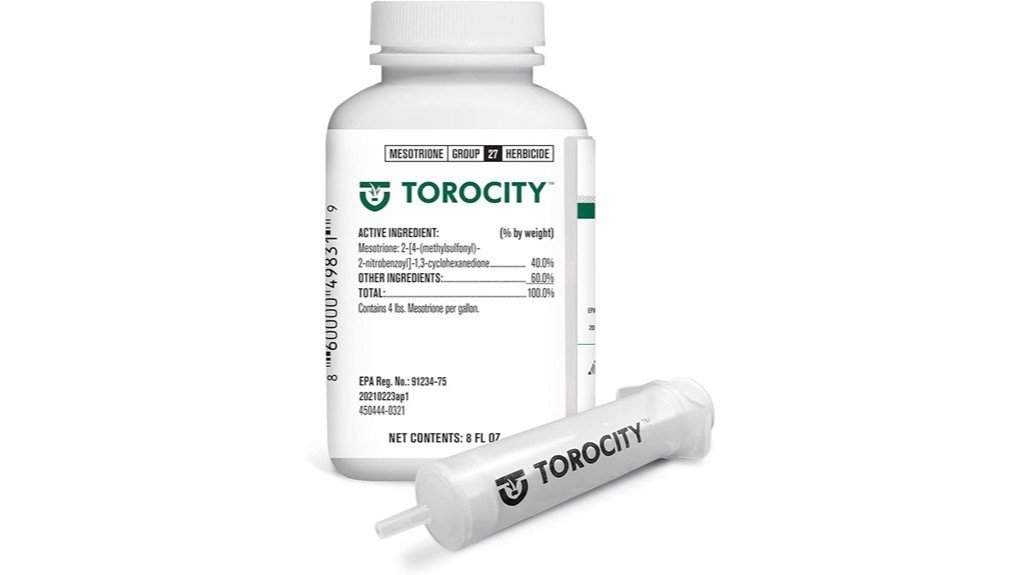
You’ll get an 8‑oz mesotrione concentrate that treats about 1,000 sq ft when mixed and gives both pre‑ and post‑emergent control of crabgrass, clover, dandelion and oxalis. It includes a calibrated syringe for precise per‑gallon dosing, needs 0.15″ irrigation or rain within 10 days to activate, and shouldn’t be used on bentgrass, zoysia or active bermudagrass. Wear PPE, jar‑test tank mixes, and expect visible broadleaf decline in weeks; more application details and timing tips follow.
Some Key Takeaways
- Mesotrione 40% concentrate in an 8-oz bottle treats up to ~1,000 sq ft when mixed at labeled rates and using the included syringe.
- Provides both pre-emergent and post-emergent control of crabgrass, clover, dandelion, and oxalis on tolerant turf.
- Requires syringe calibration, PPE during mixing, and 0.15 inches irrigation or rainfall within ten days to activate.
- Not safe for bentgrass, zoysiagrass, or active Bermudagrass; confirm turf tolerance before use.
- Competitive per-square-foot cost versus other concentrates, best applied before peak weed emergence and integrated into turf programs.
What Atticus Torocity (8 Oz) Is and Who Should Use It
Choose Atticus Torocity Herbicide (8 oz) when you need a technical, versatile solution for both pre-emergent and post-emergent control of broadleaf and grassy weeds in labeled turf species. You’ll use a mesotrione 40% liquid concentrate designed for selective control of crabgrass, clover, dandelion, oxalis, and more. You’ll value its syringe dosing, water activation, and coverage up to 1,000 sq ft for consistent results. Ideal users include homeowners associations managing shared lawns and golf superintendents maintaining playability and aesthetics. You’ll follow label restrictions—avoid bentgrass, zoysiagrass, and active Bermudagrass—and always confirm turf tolerance before treating. Incorporating this product into a regular turf fungicide program can help protect overall lawn and landscape health by reducing stress that makes turf more susceptible to disease.
How to Mix and Apply Torocity: Rates, Timing, and Turf Restrictions
Now that you know what Torocity does and where it’s appropriate, get specific about mixing and application so you apply the correct rate for your turf and situation. You’ll use the pre-marked syringe for syringe calibration, measuring dose per gallon to match labeled rates. Choose application timing based on pre- or post-emergent goals; treat newly seeded or established tolerant turf only. Make certain water activation: irrigate 0.15 inches if no rain within 10 days. Prevent runoff by avoiding applications before heavy rain, using low-pressure nozzles and keeping treated area slope and volume in mind. Read the label and follow turf restrictions. Consider integrating effective sod webworm control strategies into your treatment plan to address common lawn pests.
Weeds Controlled and Real-World Performance on Common Lawns
Torocity targets a wide range of common lawn pests—both broadleaf and grassy weeds—by combining pre- and post-emergent activity that interrupts weed emergence and disrupts established plants. You’ll see reliable suppression of crabgrass when you time applications pre-emergence and follow label irrigation; this product supports integrated crabgrass management rather than sole reliance. Established broadleaf weeds like dandelion respond within weeks, though variable dandelion resistance in some populations means follow-up monitoring and spot-treatment may be necessary. Trials on tolerant turf (rye, fescue, bluegrass) show consistent visual decline of targets without turf injury when you adhere to species restrictions and rates. Protecting your lawn with effective crabgrass barriers and proper timing improves long-term control.
Safety, Activation, and Compatibility: What the Label Requires
Having covered efficacy and turf safety on tolerant grasses, you should next focus on label-mandated safety, activation, and compatibility requirements to get predictable control and avoid damage. You must wear specified personal protective equipment during mixing and application; the label lists gloves, eye protection, and long clothing. Calibrate the included syringe per gallon of water to match label rates. Activate with 0.15 inches of irrigation or natural rainfall within ten days, or expect reduced efficacy. Respect buffer zones and do not apply near sensitive species like bentgrass. Check tank‑mix compatibility with a jar test and follow label restrictions for safe, consistent results. Consider investing in essential safety gear to protect yourself when mixing and applying lawn chemicals.
Value Verdict: Coverage, Availability, Price, and When to Buy
Because the 8-oz concentrate covers up to about 1,000 sq ft and includes a calibrated syringe for precise dosing, you’ll get predictable coverage per purchase and waste less product when treating small to medium lawns. You can quantify value by a cost comparison against other mesotrione concentrates and ready-to-use mixes: per-square-foot cost is competitive when you account for calibrated dosing and multi-rate use. Availability is broad online and in many retailers, though note regional restrictions. Buy before peak weed emergence; seasonal timing—late winter for pre-emergent or spring/early summer for post-emergent—maximizes efficacy and ROI. Homeowners should integrate it into an overall grub control and turf-care plan for best long-term lawn health.
Some Questions Answered
Can Torocity Be Tank-Mixed With Granular Fertilizers?
No — you shouldn’t tank-mix Torocity with granular fertilizers; tank mix compatibility with solids is poor and granular interaction can cause uneven distribution. You’ll get more predictable results applying the herbicide in water per label directions, then applying granular fertilizer separately after the herbicide has been absorbed or irrigation has occurred. Follow label guidance, run a jar/compatibility test for liquid mixes, and join peers in following best practices for safety and efficacy.
What Is the Product’s Shelf Life After Opening?
You’ll typically get an expiration estimate of about 2–3 years after opening if you follow proper storage conditions. Keep the concentrate tightly sealed, stored upright in a cool, dry place away from sunlight and freezing temperatures, and avoid contamination. Evidence shows mesotrione remains stable under those conditions; if the product changes color, separates, or smells off, don’t use it. You’re part of a careful user community—check the label for specifics.
Are Pets Safe on Treated Turf Immediately After Activation Watering?
No — you shouldn’t let pets on treated turf immediately after activation watering. Evidence-based labels require allowing treated areas to dry and often recommend re-entry after spray residues settle; pet exposure risk is highest before binding and drying. You should follow activation timing on the label, wait until the turf is dry and any specified re-entry interval has passed, and then let pets return to reduce contact with residues and inadvertent ingestion.
Can Torocity Be Used Near Edible Gardens or Fruit Trees?
You shouldn’t apply Torocity directly in edible garden beds or onto fruit trees; you’ll need buffer zones between treated turf and food-bearing plants. Use label directions to set distances and avoid drift during application. If you’re concerned about contamination, consider residue testing before harvest or consumption. Follow irrigation activation requirements and wait intervals on the label to minimize off-target movement, and join local user groups to share practical, evidence-based guidance.
Is a State Pesticide Applicator License Required to Buy or Apply?
No, you typically don’t need a state pesticide applicator license to buy or apply homeowner-rate products, but pesticide regulations vary by state and product concentration. Check label restrictions and your state agency: some uses or larger volumes may require applicator certification. You’ll want to confirm local rules, training, and record-keeping requirements before treating. Stay informed and connected with your community of applicators for compliance and safe, effective use.