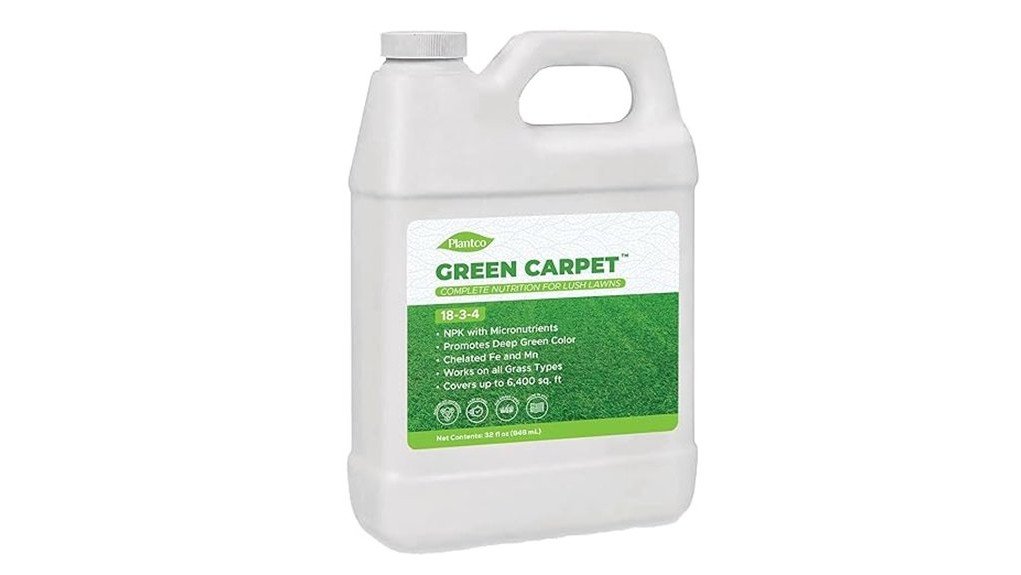
You’ll get fast, predictable greening with Green Carpet’s 18-3-4 liquid fertilizer; it’s high‑nitrogen (urea) with chelated iron and manganese for quick chlorophyll boost and visible color in days. The concentrated spray mixes 4–6 oz per 1,000 sq ft, promotes blade density and root fine‑rooting over weeks, and suits routine foliar feeds when applied every 1–2 weeks. Follow label safety, calibrate your sprayer, and continue for full application, troubleshooting, and value details.
Some Key Takeaways
- Fast-acting 18-3-4 liquid delivers rapid greening and growth within days when applied per label.
- Contains chelated iron (0.5%) and manganese (0.05%) to improve color and chlorophyll production.
- Mix 4–6 oz per 1,000 sq. ft., dilute in 1–2 gallons water, apply every 1–2 weeks during active growth.
- Concentrated spray reduces patchiness and boosts blade density, but requires recurring applications and monitoring.
- Good value for quick aesthetic results; consider granular slow‑release or organic alternatives for longer-term feeding.
Quick Verdict: Does Green Carpet Lawn Liquid Fertilizer Work and Who Should Buy It?
Although no single product fits every lawn, Green Carpet Lawn Liquid Fertilizer delivers a clear, measurable boost: its 18-3-4 NPK with iron and manganese supplies fast-acting macronutrients and trace elements that improve color and vigor within days when applied per label. You’ll see reliable results if you follow recommended mixing and application frequency—every 1–2 weeks during active growth. This concentrated spray supports soil health by delivering soluble nutrients that grass roots can uptake quickly, reducing patchiness and improving density. It’s ideal for homeowners seeking consistent, predictable improvement and who value shared practical guidance from a community of careful lawn stewards. The product is offered alongside other liquid lawn fertilizer options and related supplies for homeowners maintaining their lawn and landscape, emphasizing practical solutions for home use and liquid lawn fertilizers.
What’s in the Bottle: NPK, Micronutrients, and How the Formula Affects Lawns
Having established that Green Carpet produces noticeable results when used as directed, let’s examine what’s actually in the bottle and how each component acts on turf. You get an 18-3-4 NPK: high nitrogen for shoot growth, moderate phosphate for roots, and potash for stress tolerance. Micronutrients include Fe 0.50% and Mn 0.05% as citrates, improving chlorophyll formation and enzyme activity. Sources (urea, monopotassium phosphate, potassium hydroxide) promote rapid solubility and uptake. The liquid format supports nutrient synergy and encourages beneficial soil biology interactions without heavy salts. Apply precisely; this formulation complements routine cultural care and community lawn standards. Many homeowners prefer spray-on starters because they offer quick uptake and even coverage when overseeding or establishing new turf, making them ideal for home lawn care.
Real-World Performance: Color, Growth, Root Strength, and Speed of Results
When you apply Green Carpet as directed, expect a rapid deepening of color and a noticeable increase in blade density within days, driven by the 18% urea nitrogen and chelated iron that boost chlorophyll synthesis and turf greening. You’ll see improved color retention under heat stress and quicker recovery after traffic. Growth rate accelerates predictably with the 18-3-4 NPK, supporting uniform shoot elongation while preserving turf resilience. Root density increases measurably over weeks as available nutrients encourage finer roots and stronger anchorage. Overall performance balances visible greening and structural gains; application speed yields near-immediate aesthetics with progressive root benefits. Designed for homeowners maintaining their lawn and landscape, Green Carpet integrates easily with existing spray fertilizer routines and product setups.
How to Use It Safely and Effectively: Coverage, Mixing, Timing, and Troubleshooting
For safe, effective results, measure coverage and mix ratios precisely and apply on a dry lawn under calm conditions to guarantee even distribution and minimize drift. You’ll use 4–6 oz per 1,000 sq. ft.; calibrate your sprayer, shake the bottle, and dilute in 1–2 gallons water per 1,000 sq. ft. Prioritize application safety: wear gloves, avoid runoff, and don’t overspray near water. Conduct soil testing before major feeds and adjust frequency during season shifts. For thin patches use spot treatments at reduced dilution. If burn or uneven growth occurs, flush with water, reassess rates, and retest soil. Homeowners can pair foliar feeding with a complete foliar feeding system to boost lawn and landscape results.
Value Check: Coverage, Cost per 1,000 Sq Ft, Pros Vs Cons and Alternatives
Although a single 32 fl oz bottle is compact, it treats up to 6,400 sq ft, which gives you a clear basis to evaluate value: at that coverage the product delivers 0.5 to 0.8 oz of concentrate per 1,000 sq ft per application (using the 4–6 oz mixing range), and if you follow the recommended 1–2 week frequency you’ll plan for multiple bottles over the season. Do a cost analysis: divide bottle price by 6.4 to get cost per 1,000 sq ft. Pros: high NPK, fast uptake, concentrated. Cons: frequent application, recurring expense. Alternatives: granular slow‑release or lower‑frequency liquids. Consider pairing this product with liquid organic fertilizers for homeowners focusing on lawn and landscape care to maximize plant health and environmental benefits.
Some Questions Answered
Is This Fertilizer Safe Around Pets and Children?
Yes — you can use it, but you should take precautions. You’ll minimize pet exposure and child safety concerns by keeping kids and animals off treated areas until spray dries. Ingestion risks exist with concentrated liquid; store the bottle locked and out of reach. During playtime precautions, rinse paws or shoes if they contact wet lawn. Follow label directions, apply at recommended rates, and keep a shared neighborhood safety mindset.
Can I Store Opened Bottles Long-Term, and How?
Yes — you can store opened bottles long-term if you follow storage tips. Keep the bottle tightly sealed, upright, in a cool (40–75°F), dry, dark place away from direct sunlight and freezing temperatures. Label with opening date; bottle lifespan is typically 1–2 years if stored properly. Avoid contamination by using clean measuring tools and shaking before each use. Join others who keep supplies organized for consistent results.
Is It Compatible With Lawn Herbicides or Pesticides?
Yes — you can tank-mix cautiously, but you should avoid simultaneous application with many herbicides or pesticides because chemical interactions can reduce efficacy or harm turf. You’ll want to separate applications: apply fertilizer first or wait 24–48 hours after pesticide use, following label directions for both products. Test a small area for compatibility, maintain recommended application timing, and consult product labels or your local extension if you’re unsure, so you’ll stay safe and effective.
Can I Use It on Newly Seeded or Sodded Lawns?
Yes — you can use it, but you’ll be cautious: wait until seedlings show true leaves and have established root contact to avoid harming tender shoots. The product’s seedling tolerance is moderate; apply a diluted mix at the low end of 4 oz per 1,000 sq. ft. to reduce stress. Consider germination timing — delay first feed until after initial germination window (usually 10–21 days) so seedlings aren’t stalled.
Is This Product Organic or Approved for Organic Lawns?
No — it’s not organic and doesn’t carry organic certification. You’ll want to avoid assuming compatibility with organic lawn programs. The formula uses synthetic-derived urea and potassium hydroxide, so it won’t meet organic standards. If you prefer organic approaches, consider compost tea or certified organic fertilizers instead. You’ll still get good results with this product, but use it only if you’re comfortable outside organic guidelines and community norms.