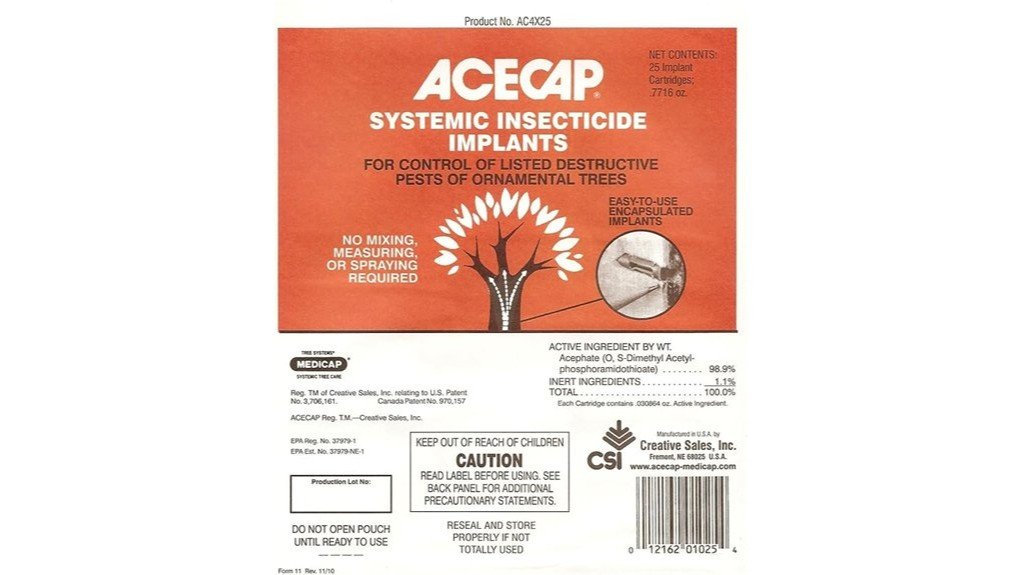
You’ll find Acecap 25‑Pack delivers high‑concentration acephate in double‑encapsulated cartridges you insert into 3/8‑inch trunk holes, giving rapid xylem translocation in 3–4 days and season‑long control of borers and foliage pests on non‑edible ornamentals. It’s designed for trained applicators, fits trees ≥3‑inch DBH, and reduces operator exposure and environmental runoff. Installation is straightforward with a drill and dowel; follow label PPE and pollinator precautions. Continue for detailed use, limits, and cost comparisons.
Some Key Takeaways
- Acecap delivers high‑concentration acephate in ready‑to‑install, double‑encapsulated cartridges for safe, measured trunk injections.
- Rapid xylem translocation moves actives through the crown in 3–4 days under normal moisture for fast control.
- Provides season‑long control on deciduous trees and up to two seasons on evergreens with consistent pest suppression.
- Designed for non‑edible ornamentals 3″+ diameter; effective versus borers, scales, caterpillars, adelgids, mites, and similar pests.
- Requires trained applicators, PPE, and tool sanitation; acephate is toxic to pollinators, so consider environmental impacts.
Quick Verdict: Is Acecap 25-Pack Worth Buying for Ornamental Tree Pest Control?
Frequently, you’ll find the Acecap 25-Pack a practical choice for systemic control of common ornamental tree pests: it delivers a high-concentration acephate payload in ready-to-install, double-encapsulated cartridges that move through a tree in 3–4 days and provide season‑long control for deciduous trees (up to two seasons for evergreens). You’ll get measurable value if you need reliable, low‑labor treatment for multiple trees. A concise cost analysis favors bulk packs for medium properties; user reviews note consistent performance and ease of install. You’ll belong to a community of practitioners who prioritize proven, efficient systemic protection without daily monitoring. This product is especially useful for homeowners managing landscape pests like Japanese beetles that damage lawns and ornamental plants.
How Acecap Works: Active Ingredient, Double-Encapsulation, Movement, and Coverage
Because acephate is a highly water‑soluble organophosphate formulated here as a 98.9% dry powder, Acecap’s double‑encapsulated implants release a controlled dose directly into the tree’s vascular system where it translocates in xylem flow; you insert premeasured cartridges into 3/8‑inch holes and the sealed design prevents operator exposure and environmental contamination while the active ingredient moves throughout the crown within 3–4 days under normal moisture, providing season‑long control in deciduous trees and up to two seasons in evergreens. You’ll appreciate the clear acephate chemistry, encapsulation dynamics, rapid xylem transport, and reliable systemic distribution for consistent pest suppression. Homeowners should still use appropriate safety gear when handling and installing implants.
Who Should Use It and Which Trees/Pests It’s Effective Against
While Acecap’s implants are straightforward to install, they’re intended for trained applicators and property owners managing ornamental trees rather than home gardeners treating edibles. You should be a professional arborist, residential landscaper, or a certified applicator comfortable with trunk-insert techniques and label restrictions. Use it on non-edible ornamentals meeting the 3-inch minimum trunk diameter—deciduous species for season-long control and evergreens for up to two seasons. The acephate formulation targets borers (including emerald ash borer), scale crawlers, caterpillars, adelgid, mites, leaf miners, thrips, whitefly and similar sucking/chewing pests. Don’t treat fruit or nut trees or restricted crabapples. Protect your lawn with effective crabgrass barriers by maintaining proper turf care and using physical or chemical prevention crabgrass barriers.
Installation Walkthrough and Tool Checklist: Drilling, Spacing, and Wound Closure Tips
Before you start, gather the required tools and plan your insertion pattern so each 3/8-inch hole is drilled accurately and implants are spaced for uniform uptake. You’ll need a tape measure, cordless drill with 3/8-inch bit, hammer and dowel or bolt; confirm drill depth equals implant length to avoid over-penetration. Mark implant spacing at 4–6 inches around the lower trunk, stagger rows for even distribution. Practice tapping to seat cartridges flush; cartridge head provides primary wound sealing while cambium closes naturally. Sanitize tools between trees to prevent pathogen transfer—tool sanitation is mandatory for responsible, communal arboriculture. Consider using core aerator machines to improve surrounding soil aeration and overall tree health.
Performance, Longevity, Safety, and Buying Considerations (Cost per Tree, Restrictions, Alternatives)
When you choose Acecap 25-Pack implants, expect rapid systemic uptake—under normal moisture the acephate moves through the tree in 3–4 days—and season‑long control for deciduous trees (up to two seasons in evergreens). You’ll see reliable performance against listed pests; longevity depends on species and size. Prioritize safety: follow label restrictions (ornamental only, ≥3″ trunk) and PPE during installation. Conduct a cost analysis: per‑tree cost varies with trunk diameter and implant count but often undercuts repeated foliar sprays. Consider environmental impact: double‑encapsulation limits operator exposure, yet acephate is toxic to pollinators—evaluate alternatives like physical controls or lower‑risk systemic options. For homeowners maintaining turf and landscape, systemic insect preventatives are an important tool for integrated pest management lawn and landscape.
Some Questions Answered
Can Acecap Be Used Around Pets or Livestock?
No — you shouldn’t allow pet exposure or assume livestock safety. Acecap implants are double‑encapsulated to prevent external residue, but they contain 98.9% acephate, a systemic insecticide meant for ornamental trees only. You’ll avoid placing treated trees where animals rub, chew, or graze; maintain barriers and follow label restrictions. If animals show symptoms or you’re unsure, contact your veterinarian or local extension for guidance to keep your animals safe.
How Soon Can I Prune Branches After Implanting?
You can prune branches after the implanting wound has progressed through the initial healing process, typically waiting 2–4 weeks for cambial response and implant sealing; this timing window guarantees minimal sap loss and continued systemic uptake. If the tree is stressed or the trunk diameter is near the minimum, wait 4–6 weeks. You’ll preserve tree health by following these timelines and staying mindful of seasonal growth and local conditions.
Are Implants Effective in Newly Planted Young Trees?
No — you shouldn’t use implants in newly planted young trees. They rely on established root uptake and sufficient vascular transport to distribute active ingredient for leaf protection; seedlings and very young transplants often lack trunk diameter and root system development. Wait until trunks reach the minimum 3-inch diameter and roots are reestablished. That guarantees effective systemic movement, minimizes tree stress, and helps the community of users share successful, responsible practices.
How Should Unused Implants Be Stored and Disposed?
Store unused implants in a cool, dry place at the recommended storage temperature (stable, below 77°F/25°C) in original sealed packaging. Keep out of reach of children and pets. For disposal, follow local disposal regulations and pesticide label instructions: don’t incinerate or pour contents down drains. Contact your local household hazardous waste facility or agricultural extension if unsure. You’ll protect your community by following these safe storage and disposal practices.
Do Implants Interfere With Tree Health Monitoring or Treatments?
No — implants won’t materially interfere with routine tree health monitoring or most treatments. You can perform leaf sampling and visual inspections normally; systemic distribution actually aids diagnostic chemistry. Avoid core sampling or root excavation directly through implant sites to prevent false positives or wound conflicts. When coordinating treatments, document implant placement and dates so your team feels included and can plan complementary therapies safely and confidently.