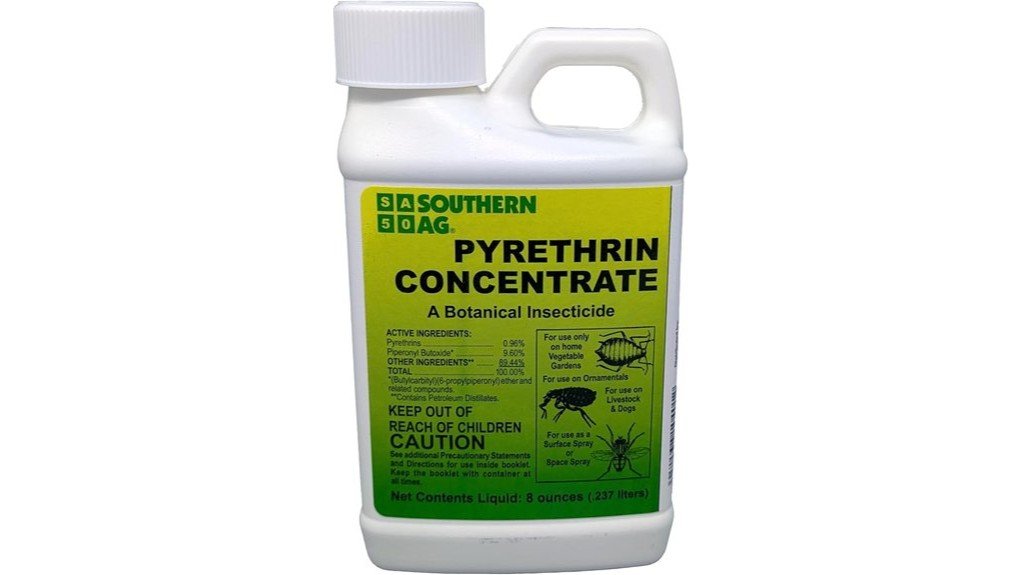
You’ll find Southern Ag Natural Pyrethrin Concentrate 10401 is a fast‑knockdown, short‑residual botanical insecticide (0.96% pyrethrins, 9.6% piperonyl butoxide) formulated for sprays, dips and space treatments on vegetables, ornamentals, pets, livestock and outdoor mosquitoes. You’ll get reliable contact mortality on soft‑bodied pests, flies and fleas but limited persistence, so follow label dilutions, PPE and reapplication intervals. It’s best for quick control; continue for detailed use rates, safety and alternatives.
Some Key Takeaways
- Fast knockdown of mosquitoes, flies, aphids, fleas, and many larvae but limited effectiveness on heavy infestations.
- Short residual activity; expect reapplication within days under high pest pressure.
- Versatile: labeled for vegetables, ornamentals, indoor areas, livestock, pets, and outdoor space sprays.
- Dilute per label (≈2.5–10 mL/L for plants), follow PPE, reentry intervals, and wash produce before consumption.
- Good choice for quick, botanical knockdown; rotate with other modes to reduce resistance and extend control.
What Southern Ag Natural Pyrethrin Concentrate 10401 Actually Is and What’s in the Bottle
Although it looks like a simple brown bottle, Southern Ag Natural Pyrethrin Concentrate (Model 10401, 8 oz) is a formulated spray concentrate containing 0.96% pyrethrins and 9.6% piperonyl butoxide in a carrier solution, designed for multiple application methods (thorough spray, dip, surface and space spray) across vegetables, ornamentals, indoor areas, livestock, pets and outdoor mosquito control. You’ll get a clear ingredient breakdown: active pyrethrins 0.96%, synergist piperonyl butoxide 9.6%, balance carrier and inert components. Packaging details note an 8 oz brown bottle, UPC 051538104012, single included component; label and SDS downloadable for precise rates and precautions. This product is suitable for homeowners managing small lawns and landscapes who need targeted pest control in confined spaces like patios and container gardens, especially when following small-space fertilizer practices.
How Well It Works: Pest Control Performance by Use Case (Vegetables, Ornamentals, Pets, Livestock, Mosquitoes)
With the formulation and concentrations established, we can assess performance across common use cases by comparing labeled application rates, target pest biology, and expected knockdown/residual effects. You’ll find effective knockdown against soft-bodied pests (aphids, whiteflies, many larvae) on vegetables and ornamentals at label rates; residual protection is short, so reapplication fits integrated crop protection schedules. For pets and livestock, rapid contact mortality controls fleas, lice, mites and flies but contact and retreatment limitations require monitoring. For outdoor and space treatments targeting urban mosquitoes and nuisance flies, expect immediate reduction in adults with limited residual control; integrate with habitat management. As a non-toxic-focused option for homeowners, consider combining this product with eco-friendly pest control practices like habitat modification and biological controls to reduce repeat treatments.
How to Use It Safely and Effectively: Dilution Rates, Application Methods, and Timing
When preparing Southern Ag Natural Pyrethrin Concentrate for use, calculate dilutions precisely and follow labeled rates to guarantee efficacy and safety: for vegetables and ornamentals mix 2/3 to 2 teaspoons per gallon (about 2.5–10 mL/L), while other applications (surface, space, mosquito, livestock, pet dips) require specific concentrations printed on the label. You’ll apply sprays during peak pest activity, early morning or dusk for mosquitoes, avoiding heat stress on plants. Prioritize human safety with PPE, drift control, and reentry intervals. Monitor storage conditions, rotate treated areas, and perform routine equipment maintenance to preserve dose accuracy and product integrity. Choose the right sprayer for large properties to ensure even coverage and efficient application, especially when treating expansive lawns and landscapes with boom sprayers.
Pros, Cons, and Real-World Tips From Users (Efficacy, Safety, Scent, Residual Activity)
Having covered dilution, timing, and protective measures, let’s examine how the product performs in real-world use. You’ll find rapid knockdown against flies, mosquitoes, aphids and fleas consistent with 0.96% pyrethrums plus 9.6% PBO; efficacy drops on heavy infestations. Users report low toxicity when label-followed, but residue concerns arise on edible surfaces—wash produce after application. Scent strength is noticeable initially yet dissipates within hours. Residual activity is short-lived; expect reapplication within days for high pressure. Tip: test small area, document results, and rotate control methods to mitigate resistance while staying within label safety requirements. This product fits well within an eco-friendly grub control approach for homeowners maintaining lawns and landscapes.
Who Should Buy It and Where It Fits vs. Alternatives (Best Use Cases and Buying Checklist)
Although labeled uses are broad, you should buy Southern Ag Natural Pyrethrin Concentrate if you need a fast-knockdown, short-residual pyrethrum-based spray for vegetables, ornamentals, indoor spaces, and livestock/pet treatments, especially where rapid control of flies, mosquitoes, aphids, fleas, mites, and similar pests is required. You’re the gardener or livestock caretaker who values low-residue, EPA-registered botanical chemistry and quick efficacy. Use the gardeners checklist: confirm target pest, dilution rate, preharvest interval, PPE, and label rates. Pet owners should note dog-dip instructions, rinsing, and safety intervals. Choose alternatives (longer residual synthetics, insect growth regulators) when persistence or systemic action is required. Consider matching the product to your lawn fungicide sprayer to ensure proper application and coverage.
Some Questions Answered
Is This Product Safe Around Pollinators Like Bees and Butterflies?
No — you shouldn’t assume bee safety; pyrethrins can cause acute harm to bees and other pollinators if exposed during foraging. Evidence shows natural pyrethrins plus piperonyl butoxide increase pollinator impacts, especially with direct sprays or drift. You should apply only when pollinators aren’t active (dawn/dusk), avoid blooming plants, and follow label precautions. That helps protect bees, butterflies, and community gardens where you and neighbors share habitat.
Can It Be Mixed With Other Pesticides or Fertilizers?
Yes — but you shouldn’t assume compatibility. You’ll need to perform compatibility testing and follow label guidance before tank mixing with other pesticides or fertilizers. Mix small proportions in the proper water and observe for separation, precipitate, or pH reactions over 30 minutes. Use recommended rates, adjuvants, and PPE. If label prohibits mixes, don’t combine. Share results with peers so your group can build collective, evidence-based compatibility knowledge.
How Long Should Treated Pets Be Isolated From Children?
You should wait at least 24 hours after treating pets before allowing unsupervised child contact; during the first 24–48 hours, allow only brief, supervised interaction. Follow label instructions and any product-specific waiting period; wash treated areas and your hands after handling pets. If irritation or product residue is visible, extend supervision until fully dry and residue-free. This evidence-based approach balances safety and belonging for all household members.
Does the Concentrate Have Any Temperature Storage Restrictions?
Yes — you should store the concentrate within manufacturer-recommended storage temperature ranges to preserve efficacy and container integrity. Keep it in a cool, dry place away from heat sources and freezing; extremes can degrade pyrethrins and compromise seals. Inspect the bottle for leaks or warping periodically. Follow the label and SDS for specific numeric storage temperature guidance, and if uncertain, contact Southern Ag for precise temperature limits to guarantee safe, effective storage.
Are There Restrictions for Use Near Water Bodies or Fish Ponds?
Yes — you should avoid applying near ponds or sensitive water due to documented aquatic toxicity of pyrethrins and piperonyl butoxide. You’ll follow label directions that require buffer zones and reduced drift; maintain recommended setbacks, avoid direct runoff, and don’t treat water. Check the product label/SDS for specific buffer zone distances and mitigation measures. You’ll protect aquatic life by adhering to labeled application rates, timing, and containment practices.